Same price per token, smaller bill: what a job costs
Claude Sonnet 5.5 costs exactly the same per token as the model it replaces, yet it is sold as up to 30% cheaper per task. We ran 3 models on the same jobs to see how that can be true. The answer shows what an AI bill is made of, and it applies to every model.
9 min read · Last checked 14 October 2026
Take this lesson into your AI
Open in ChatGPT (new tab)Open in Claude (new tab)
Same fare, different bill
 Watch this part · 1:23Claude Sonnet 5.5: same token price, so why is it cheaper?
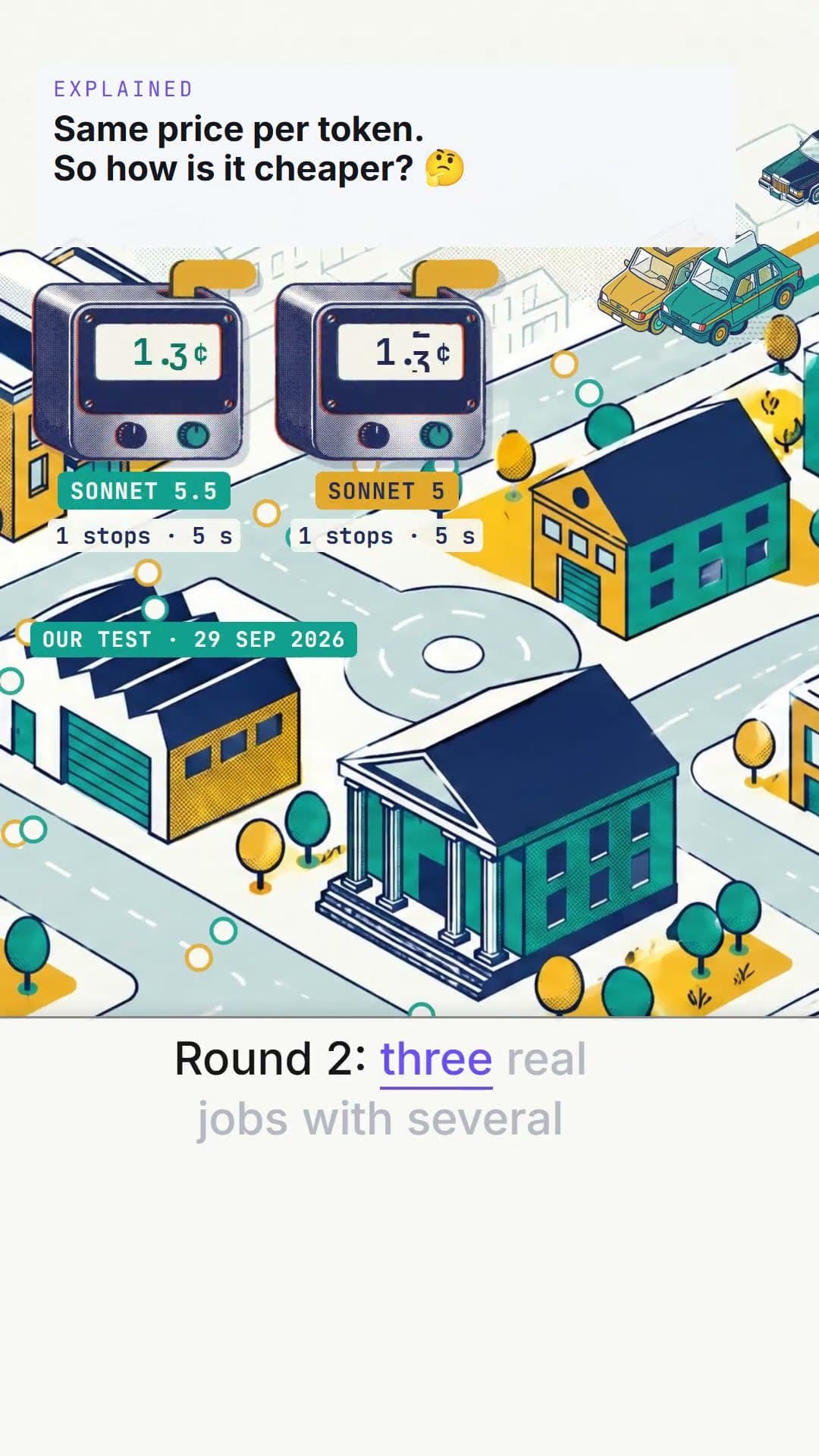
Picture 2 taxis. They are the same car, with the same fare on the door, making the same trip across town. One meter stops at 12 cents. The other stops at 15.
The first taxi is Claude Sonnet 5.5, which Anthropic released on 28 September 2026. The second is Sonnet 5, the model it replaces. Per tokenTokenThe small piece of text a language model reads and writes, often part of a word. Prices, limits and the context window are all counted in tokens. they cost exactly the same. Yet the new one is sold as up to 30% cheaper per task, on its maker's own tests.
So we put it on the meter ourselves: 2 rounds, 3 models, the same jobs. One round matched the promise. The other did not. The reason applies to any model you will ever pay for.
The price puzzle
Start with the price, because this is where most people go wrong.
| Model | Per million tokens in | Per million tokens out |
|---|---|---|
| Sonnet 5.5 | $2 | $10 |
| Sonnet 5 | $2 | $10 |
| Opus 5.5 | $4 | $20 |
You may have read that Sonnet 5 went up to $3 and $15 on 1 September. It did not. That rise was cancelled and the launch price stayed.
So the saving is not a price cut. At the same price there is only one way a job can cost less: fewer tokens to finish it.
Back to the taxi. The fare per kilometre is the price per token. The distance is how many tokens the job takes. With the same fare and a shorter drive, the bill is smaller. That is the whole promise.
What the meter counts
The meter counts tokens, the small pieces of text a model reads and writes. Your question goes in as tokens. Every word of the answer comes out as tokens. Every big model works this way, whether it is Claude, ChatGPT or Gemini. The bill is tokens times price.
There is one line on the receipt most people never see. When a model stops to think before it answers, those thinking tokens are billed too, as output, at the higher price.
So a model that thinks more can cost more, even when its answer is exactly the same length. This is the twist in round 1.
How we tested
We ran 3 models: Sonnet 5.5, Sonnet 5, and Opus 5.5 at twice the fare.
- Every model got the same prompt, the same short instructions and no extra files.
- Every model ran at the same effort setting, Medium, which is the default in the Claude apps.
- Every job ran twice and we took the middle value.
- Costs are worked out at the public list prices, so you can check the sums.
We ran 2 rounds because they answer 2 different questions. Round 1 is quick questions, the kind you type into a chat app every day. Round 2 is small jobs with several steps, where the model uses tools and checks its own work.
It is a small test. Read it as a direction, not a verdict.
Round 1: quick questions
We asked 6 everyday questions: plan a 5-day trip in New Zealand, fix a small bug, write a budget, an email and a slide outline from a page of notes, and count the r's in strawberry.
Speed. Sonnet 5.5 wrote about 105 tokens a second against 73 for Sonnet 5. That is 45% faster. The speed claim holds.
Cost. Across all 6 questions Sonnet 5.5 used 43% more tokens and cost 28% more.
Faster but more expensive? Look at what happened before the first word. On the trip and the budget, Sonnet 5.5 chose to think first, with about 900 tokens of thinking on the trip alone. Sonnet 5 barely thought at all. The answers you actually read were only about 4% longer. The extra cost was almost all thinking, a detour you never see that still runs on the meter.
Was the thinking worth anything? We read every answer.
- The easy ones everybody got right: 3 r's in strawberry, every email, every slide outline.
- On the bug, all 3 models found it. But Sonnet 5 slipped twice. Once it said the broken code returned 3.5 when it returns 2.33, and once it said a tricky case was handled when it was not. Sonnet 5.5 and Opus 5.5 got it right both times.
- On the trip, Sonnet 5.5 and Opus 5.5 planned both islands. Sonnet 5 stayed on one island each time.
On a sample this small that is a hint and not proof. On a short hop across town, the new model spends a little more to think, and its answers came out more careful.
Round 2: jobs with steps
Round 2 is where the promise should show. We set 3 small jobs, each needing several steps: fix 5 bugs and keep going until every test passes, clean up a messy spreadsheet of expenses and total it, and turn meeting notes into an email and a 5-slide outline.
Each step is a round trip. The model thinks, uses a tool, looks at the result and decides what to do next.
| Our test, all 3 jobs | Sonnet 5.5 | Sonnet 5 |
|---|---|---|
| Steps | 11 | 14 |
| Time | 51 seconds | 67 seconds |
| Cost | 12.1 cents | 15.0 cents |
That is 24% faster and 20% cheaper.
Why fewer steps? Not because it did less work. Across every run, both models used their tools the same number of times. Sonnet 5.5 bundles several of those calls into one step and does not drive back and forth.
The biggest gap was the spreadsheet. Sonnet 5 stopped to thinkChain of ThoughtHaving a model write out the steps of its reasoning before it gives an answer. Once a prompting trick, now built into "thinking" models. for about 340 tokens on each run. Sonnet 5.5 took about 65. This time the older model took the detour.
And the work itself? Every model finished every job in both runs and passed every check. The tests were green, the totals were right, and not one number was made up.
The promise was up to 30%. We measured 20% on 3 small jobs. It is not the headline number, but it is a real saving that points the same way.
The luggage nobody mentions
 Watch this part · 1:14Hidden tokens that made Sonnet 5.5 look cheaper
There is a catch in testing AI models that almost nobody talks about, and it nearly fooled us.
We ran the test inside Claude Code, Anthropic's coding tool. Claude Code sends every model a set of instructionsSystem PromptInstructions the builder of an AI app gives the model before you type anything. It sets the role, the tone and the rules, and it outranks what users say. for its tools. For Sonnet 5 that set is about 4,000 tokens heavier than for Sonnet 5.5, on every single step. With the default setup it is about 7,000.
That has nothing to do with the model. It is luggage the tool puts in the boot, and you pay to carry it on every step.
So before comparing, we gave every model the same short instructions and took the extra weight out.
- With the luggage left in, Sonnet 5.5 looks 25% cheaper.
- With it taken out, 20%.
5 points of that saving were the luggage and not the model. If you work in Claude Code you really do get the bigger number, because the luggage is on your bill too. It just is not the model's doing.
So if you ever compare models yourself, weigh the bags first. Check what your tool sends, not only what you type.
Do you need the bigger model?
Opus 5.5 costs twice as much per token as either Sonnet.
On our 3 jobs it passed exactly the same checks for 27.6 cents. That is 83% more than Sonnet 5 and more than double Sonnet 5.5. On the quick questions its trip plan was the most complete of all, but the Sonnets got the same things right for a fraction of the cost.
Anthropic says Opus still pulls ahead on long, open-ended work that needs sustained judgement. That is exactly the kind of job our small test did not cover.
Our rule of thumb: start with the smaller model. Move up when you can see it struggling, not before.
Why bigger jobs save more
If the saving is real, why did we see only 20%? Because the size of the job decides it.
- A quick question: there is hardly any distance to save. In our test it cost more.
- Small jobs with a few steps: a fifth less.
- Big jobs: the gap grows fast. On a test of agentsAgentA model that uses tools in a loop, deciding each next step from what the last one returned, until the task is done. working at the command line, Anthropic reports that Sonnet 5.5 at Medium effort beats Sonnet 5's best score for less than a tenth of the cost. On 2,441 finance tasks, the firm Balyasny saw about 121,000 tokens per answer against 497,000 for Sonnet 5.
The longer the drive, the more a shorter route saves. That is our reading and not a measurement, and it is why your own saving depends on your own work.
What to do with this
If you use a chat app
- For everyday work and anything with several steps, the newer model is the better choice.
- The effort setting controls how long the model thinks before answering. For quick questions turn it down to Low. In our test that used 21% fewer tokens with the same answers.
If you run a team or a product on the API
- Measure cost per task, not price per token.
- Run your own jobs through both models, twice, and weigh the bags.
- On Sonnet 5.5 the API starts on High effort, not Medium, and thinking can no longer be switched off.
- Coming from Sonnet 4.6 or older? Count your tokens again. The same text makes about 30% more.
The same sum works for any model from any maker: tokens in times the price in, plus tokens out times the price out, with thinking counted as output. The price calculator does that sum for the current models.
What changes for you
I used to think the price per token tells me what a model costs. Now I know the bill is that price times the tokens the job takes, and thinking is billed too, so I compare models by the cost of a finished job.
Try it with your own AI
Find the detour
This takes about 10 minutes in an assistant that has a Thinking switch or an effort setting. You cannot see the tokens in a chat app, but you can see the time, and thinking time is tokens you pay for.
- Set the assistant to its fastest mode or lowest effort. Send the first prompt and note how long the answer takes to start.
- Turn Thinking on, or set effort to high. Send the first prompt again in a new chat and compare.
- Send the second prompt in both modes, each in a new chat. Check both totals against the answer under "What to look for".
Prompt 1. A quick question
How many r's are in strawberry? Reply with the number only.
Prompt 2. A job with steps
Here are 6 expenses: taxi 18.40, lunch 12.90, taxi 18.40, hotel 142.00, train 36.50, lunch 9.80. Remove the exact duplicate. Group the rest by type, total each group and give the grand total.
What to look for
- Both modes should answer 3 to the first prompt. If the thinking run took longer to start, that wait was thinking you paid for and the answer did not change.
- The grand total for the second prompt is 219.60. The groups are taxi 18.40, lunch 22.70, hotel 142.00 and train 36.50.
- If the fast run got the total wrong or kept the duplicate taxi, the thinking was worth its cost on this job. That is the pattern from our test. A quick question does not repay the detour, and a job with steps can.
- If both modes got both prompts right, you have seen the other half. For work this size the cheaper setting was enough.
Check yourself
3 questions, each in a new situation
1. 2 models have the same price per token. On the same job, one costs 12 cents and the other 15. What explains it?
Not quite. The bill is tokens times price. With the price equal, only the token count can differ. In our test the newer model reached the end in 11 steps where the older one took 14, and each step sends tokens through the meter. The answers passed the same checks.
2. A model answers a short question with a short answer, but the bill is higher than you expected. What is the most likely cause?
Not quite. When a model thinks before it answers, those thinking tokens are billed as output, at the higher price, even though you never read them. In round 1 of our test the newer model's visible answers were about 4% longer and its cost was 28% higher. Almost all of the difference was thinking.
3. Your team wants to know whether a new model would be cheaper for its work. What is the best way to find out?
Not quite. Price per token is half of the bill. The other half is how many tokens your kind of job takes, and that changes with the job. Our own test gave 28% more on quick questions and 20% less on jobs with steps. The same instructions matter because the tool you test in can add tokens of its own.
Sources
Where each fact comes from
This page was last checked against these sources on 14 October 2026.
- 1Introducing Claude Sonnet 5.5
Anthropic · 28 September 2026
Sonnet 5.5 was released on 28 September 2026. It is priced the same as Sonnet 5, at 2 dollars per million input tokens and 10 dollars per million output tokens. Anthropic says it costs up to 30% less per task and writes more than 30% faster. Medium effort is the default in the Claude apps. On Terminal-Bench at Medium effort it beats Sonnet 5's best score for less than a tenth of the cost per task. The firm Balyasny saw about 121,000 tokens per answer against 497,000 for Sonnet 5 across 2,441 finance tasks. Opus 5.5 remains stronger at long, open-ended work that needs sustained judgement. Sonnet 5.5 can bundle several tool calls into one step.
- 2Pricing
Anthropic, Claude API documentation · 14 October 2026
Opus 5.5 costs 4 dollars per million input tokens and 20 dollars per million output tokens, twice the price of Sonnet 5.5 and Sonnet 5. The rise in Sonnet 5's price that was planned for 1 September 2026 did not happen, and its launch price is now the standard price.
- 3Migrating to Claude Sonnet 5.5
Anthropic, Claude API documentation · 29 September 2026
Thinking tokens are billed as output tokens. On Sonnet 5.5 thinking cannot be set to "disabled", and "between tools" is the lowest setting. Sonnet 5.5 and Sonnet 5 divide text into tokens the same way, and the same text makes about 30% more tokens than on Sonnet 4.6.
- 4Claude Sonnet 5.5: same price, 30% cheaper? We tested it
Tecyfy, on YouTube · 29 September 2026
Every figure marked "our test". We ran Sonnet 5.5, Sonnet 5 and Opus 5.5 in Claude Code print mode on 29 September 2026, in 2 rounds, with 2 runs of each job and the same prompt, the same short instructions and Medium effort for every model. Costs are worked out at the public list prices.