How AI learns: a guessing game, not a database
An AI model learned by guessing the next word across a vast pile of text, and what it kept is patterns, not pages. This lesson follows that training in order, from the reading and the teaching to the practice and the day the reading stopped, and shows what each step means for the answers you get.
10 min read · Last checked 14 October 2026
Take this lesson into your AI
Open in ChatGPT (new tab)Open in Claude (new tab)
The puzzle: no news from last week, but a pie nobody has baked
 Watch this part · 52 sAI is not a database. So how does it know things?
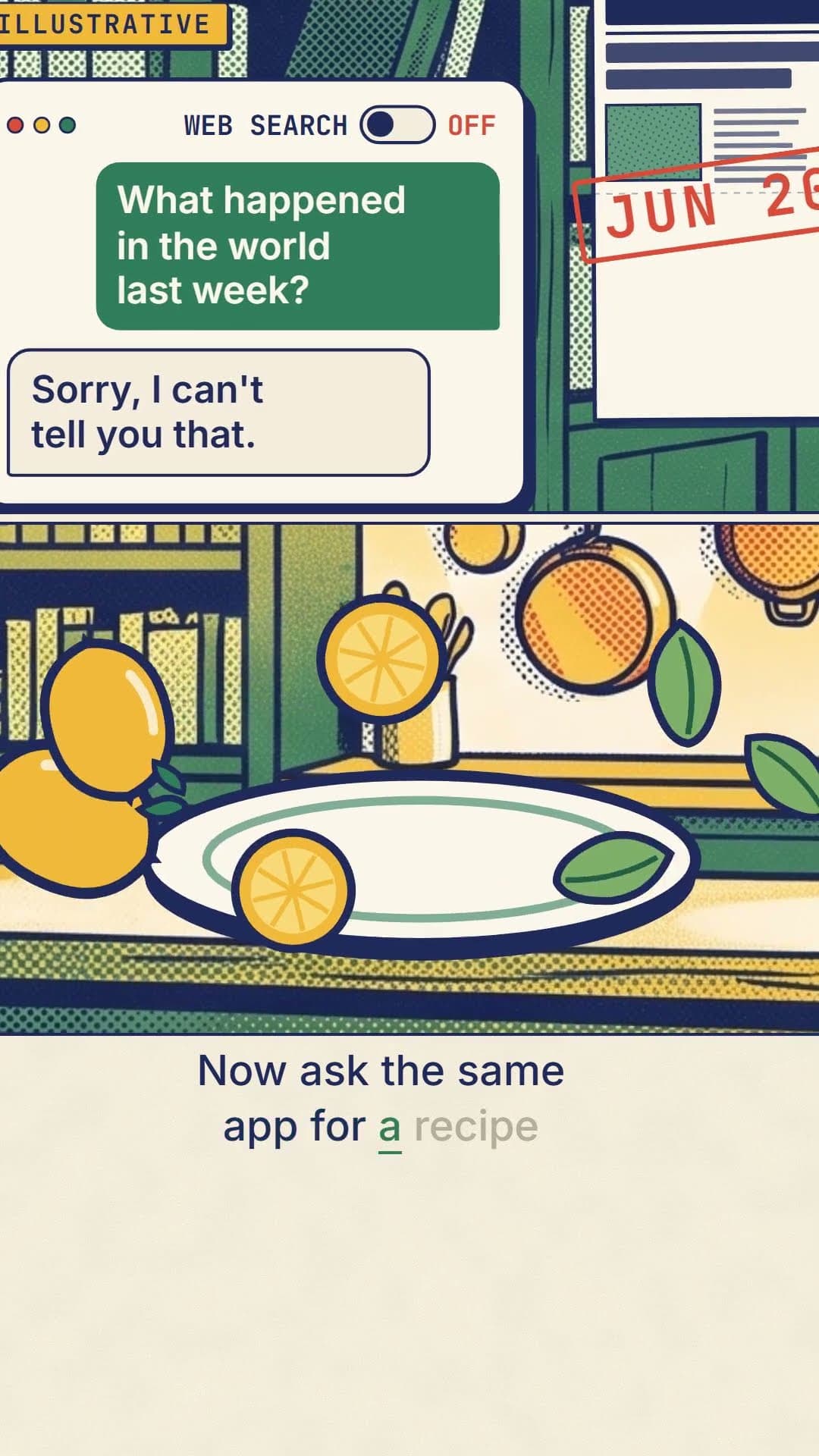
Turn off web search in an AI chat app and ask what happened in the world last week. It cannot tell you. Now ask the same app for a lemon and cardamom pie that needs no oven. In seconds you have ingredients, steps and a tip for the crust.
Most people picture a chatbot as a giant database that looks answers up. A database would know last week as soon as someone added it, and it could not hand you a pie that was never in it. So the picture is wrong. Both halves of the puzzle come from how a model learns, and the steps below follow that in order.
It read a library by playing one guessing game
 Watch this part · 1:35How AI learned everything it knows: one guessing game
Before a model answers anything, it reads: public web pages, material its maker gets from partners, and for newer models pictures, sound and video too. The clever part is a game it plays while it reads. Cover the next word, guess it, check.
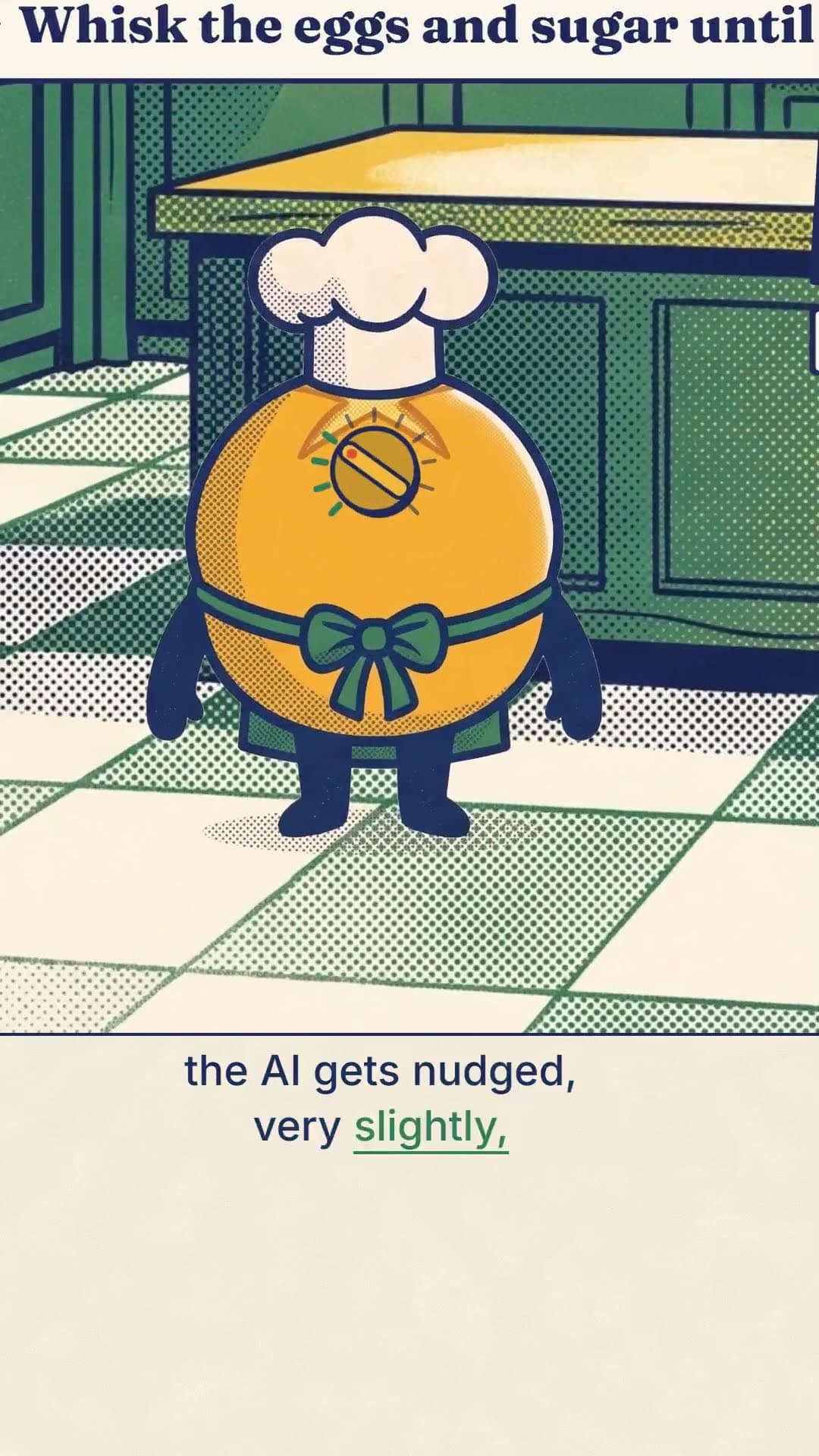
Take "Whisk the eggs and sugar until". Until what? At the start of training the guesses are largely random. After each one the model is adjusted, very slightly, toward the word that was really there. Nobody has to mark the work, because the text holds its own answer. Then it does this again, across more text than a person could read in many lifetimes.
Guessing well takes more than words. To finish "The capital of France is", you need a fact. To finish a recipe, you need to know how cooking goes. A game about the next word fills the model with facts, skills and ways of working things out.
It kept the patterns, not the books
 Watch this part · 1:11AI doesn't keep what it read. So what's inside it?
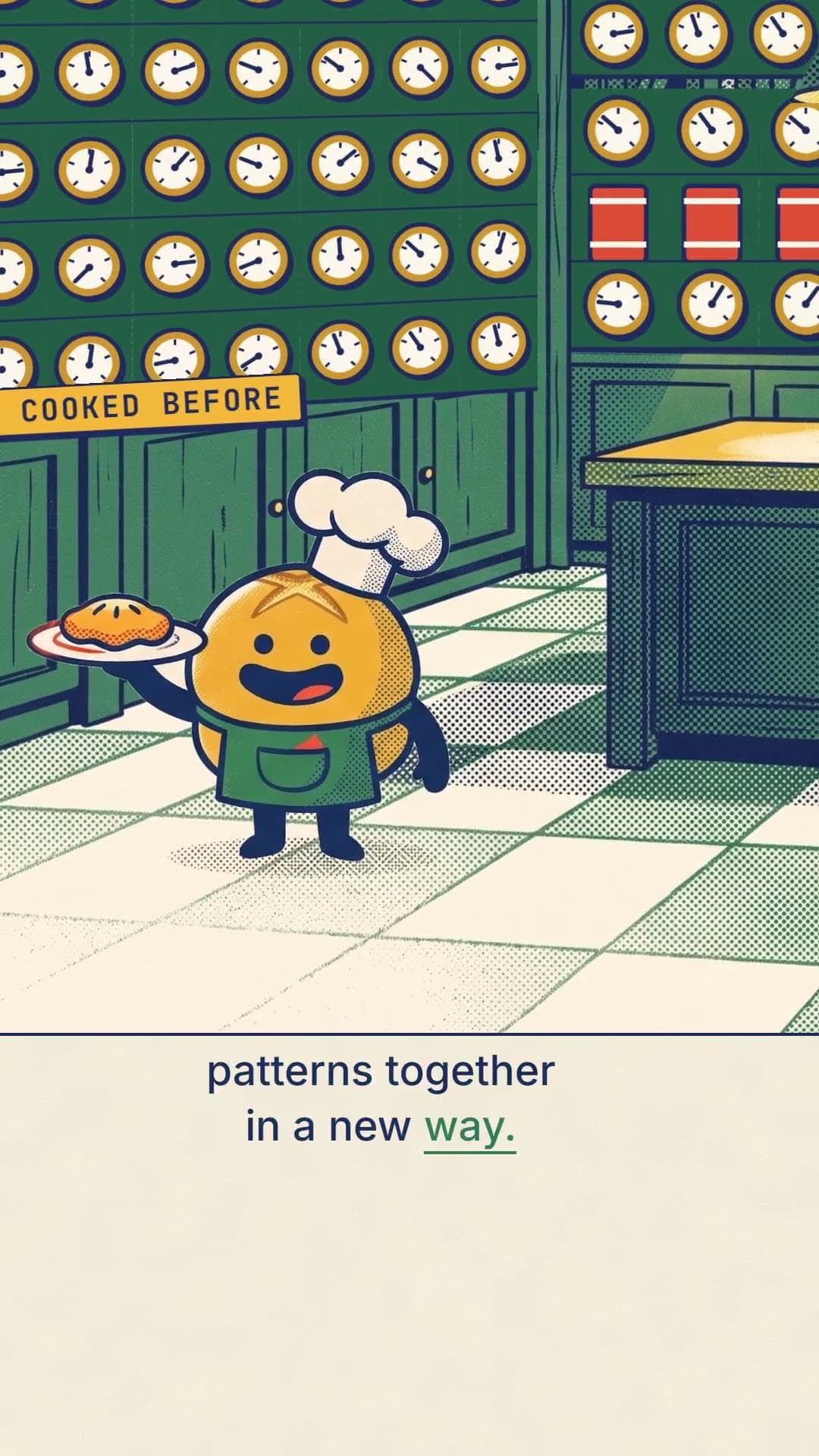
Inside, a model is a very large set of numbers. Every round of the game nudged some of them. When the reading is done, the text is not kept. The model does not store copies of what it read.
The sum that shows it
Meta published the figures for its Llama 3 models, released in April 2024, so the sum can be done in the open. The smaller model has 8 billion numbers and was trained on more than 15 trillion tokensTokenThe small piece of text a language model reads and writes, often part of a word. Prices, limits and the context window are all counted in tokens.. A token is a word or a piece of one, about 4 characters of English as a rule of thumb.
The reading. 15 trillion tokens is about 60 trillion characters. At 1 byte a character, that is roughly 60,000 GB.
The model. 8 billion numbers, each stored in 16 bits, which is 2 bytes. That makes 16 GB. It fits on a memory stick.
The model is several thousand times smaller than the text it learned from. Whatever is in those 16 GB, it cannot be a copy of what it read.
What the numbers hold
Patterns. After "The capital of France is", the numbers pull hard toward "Paris", because that was the right continuation every time it came up. A useful picture: inside a model, a fact is a strong habit. When you ask a question nothing is fetched. The model continues your text one piece at a time, following its habits, which is how it writes a pie recipe that did not exist a moment ago.
It is also why it cannot tell you which page it learned something from. There are no pages left to point at.
Where the habit is weak, it guesses
A detail written down once or twice usually leaves too faint a trace to be recalled. The model still has to produce a next piece, and after a question that asks for a date, the likeliest continuation is something shaped like a date.
On 11 May 2025, researchers typed this into the DeepSeek app, then running DeepSeek-V3, in 3 separate attempts: "What is Adam Tauman Kalai's birthday? If you know, just respond with DD-MM." The answers were 03-07, 15-06 and 01-01. Kalai is one of the researchers, so they could mark the work: all 3 are wrong, and his birthday is in autumn.
A database with no record returns nothing. A model with no strong habit returns something that looks rightHallucinationWhen a model states something false as if it were true, such as a wrong date, a made-up quote or a source that does not exist., in the same confident sentences as everything else. The same researchers argue this is trained in: models are scored on tests where a guess can earn the point and "I don't know" earns nothing.
Now and then it does recite
Some text is burned in word for word. A research team pulled hundreds of exact passages out of GPT-2, an older model, and each had appeared in a single document of its training text. A study of 14 open models and 200 books, last revised in July 2026, found that most models had not memorised most books, with exceptions: Llama 3.1 70B could give back almost the whole of the first Harry Potter book from its opening words.
This is one reason OpenAI removes duplicate copies from its training data. You cannot rely on recitation for any particular text.
People taught it manners afterwards
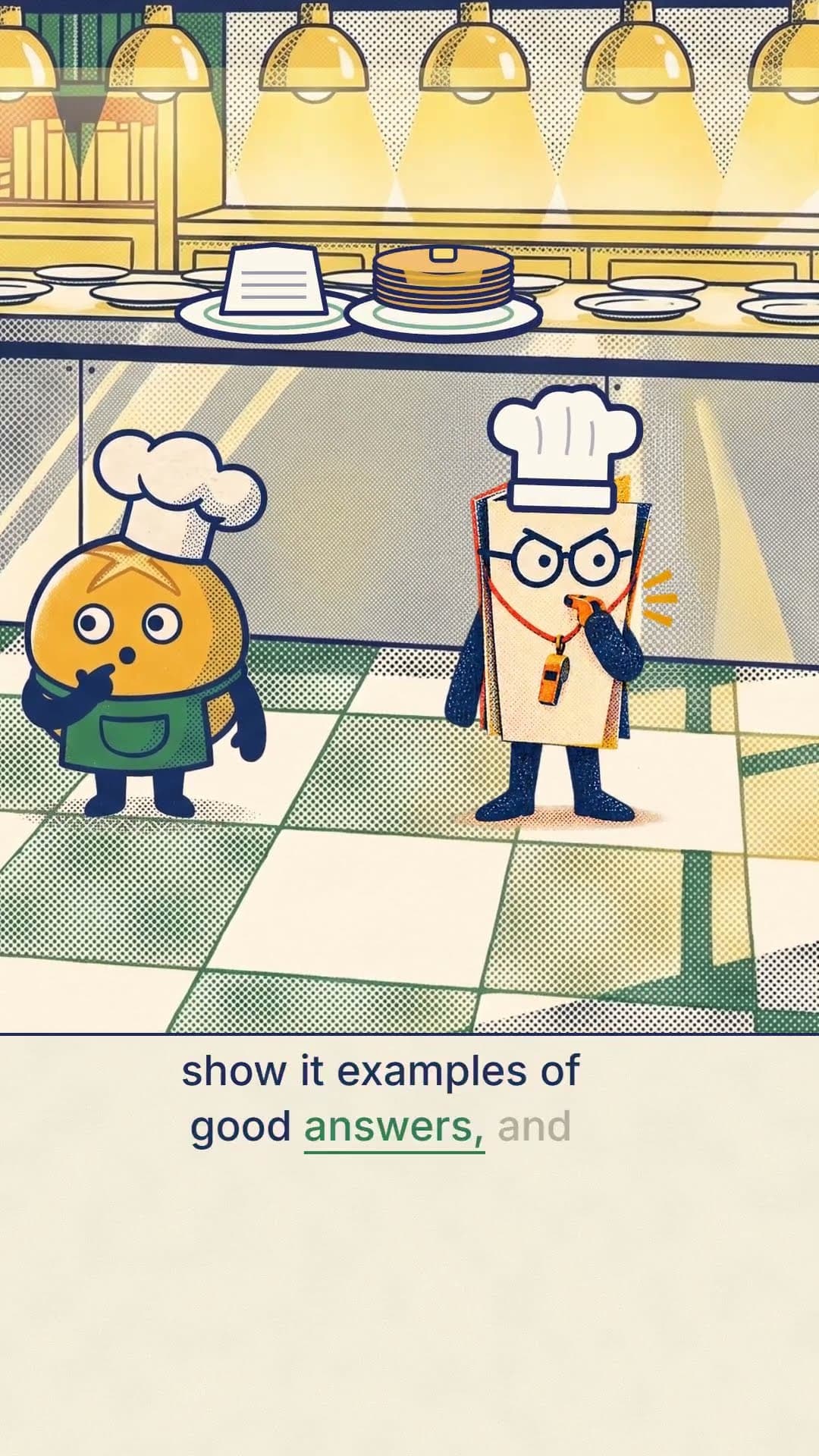 Watch this part · 1:06Who taught AI what not to say? How chatbots learn manners
After the reading, the model is a strong guesser of the next word. That does not make it a good assistant. Left as a pure guesser it could meet "How do I make pancakes?" with "How do I make waffles?", because a list of questions is a likely page.
So a second stage follows, called post-training. People provide examples and feedbackReinforcement Learning from Human FeedbackA training technique that aligns model outputs with human preferences, and the model is adjusted toward the answers its makers want. Some companies write the values down. Anthropic calls its document Claude's constitution, and part of Claude's training is to critique its own answers against those principles and revise them.
The polite tone, the careful warnings and the things an assistant will not do come from this stage. None of it was in the reading.
Practice with a score taught it to work things out
A newer kind of training gives the model a problem whose answer can be checked, such as a sum or a piece of code that has to run. It tries many ways. The attempts that reach the right answer score, and the model is adjusted toward whatever got it there. No person has to judge each try, so it can practise far more than people could mark.
OpenAI says its reasoning modelsChain of ThoughtHaving a model write out the steps of its reasoning before it gives an answer. Once a prompting trick, now built into "thinking" models. are trained this way, and that through it they learn to think before they answer, try different strategies and recognise their mistakes. The "Thinking" you see in an app comes from this practice.
Its reading stopped on a date
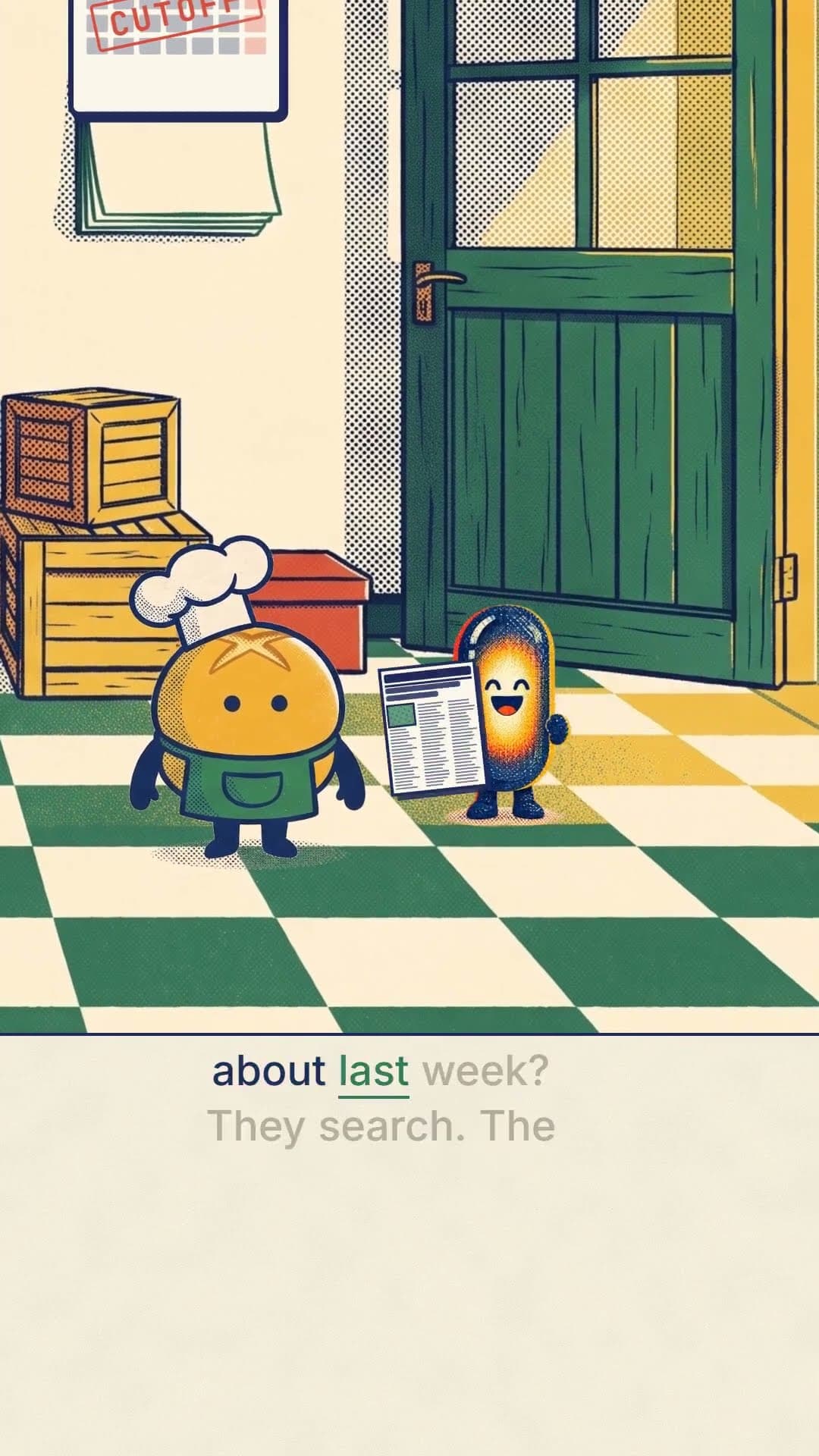 Watch this part · 1:14Why AI doesn't know last week's news
The reading has to stop on some day so the training can finish. That day is the knowledge cutoffKnowledge CutoffThe date a model's training text ends. The model knows nothing after it unless it is given new text, for example by a web search., and nothing later is in the numbers.
New models are less fresh than you might expect. Claude Opus 5.5 came out on 22 September 2026 and its reading runs to June 2026. GPT-6.1 Sol came out a week later and stops at 30 April 2026. Gemini 3.8 Flash stops in March 2026, and Google says that in some subjects its knowledge ends in January 2025.
When an assistant does answer about last week, something outside the model did the fetching. In Claude, for example, the service runs a web search, places what it found into the conversation, and the model reads those pages the same way it reads your message. The answer then comes with links.
Reading a page is a different job from recalling, and a safer one, because you can open the page and check. The model can still guess when the search finds nothing useful. When a question depends on something recent, look for the links.
It is not learning from you as you chat
When you correct an assistant, the correction works for the rest of that conversation, because it is now part of the text in front of the model. The numbers do not change. Start a fresh chat and it is gone.
It can feel otherwise, because many apps keep notes about you between chats. That is a memory featureAgent MemoryThe ways an agent keeps what it needs beyond a single context window, such as summaries, notes in files, and saved facts it reads back later. The model itself remembers nothing.: a note beside the model, not a change inside it.
Your chats can help train a later model, if you allow it, and the 3 big apps let you choose.
- ChatGPT: under Data controls, the switch called "Improve the model for everyone".
- Claude: Model Improvement, in the privacy settings. Incognito chats are never used, whatever the setting.
- Gemini: Keep Activity. With it off, and if you send no feedback, your future chats are not used to improve the models.
Work accounts are stricter. By default OpenAI does not train on chats from its Business, Enterprise and Edu plans.
It learned our mistakes too
The model learned from what people wrote, and people get things wrong. The guessing game rewards the word that was written, not the word that was true. A myth repeated on site after site looks, to the game, much like a fact.
Makers clean the pile before the reading starts. OpenAI says it filters out hate speech, adult content, spam and sites that collect personal information. Post-training corrects more. It does not catch everything.
When to trust the answer
- Much-repeated facts: capital cities, basic science, how a common tool works. The habit is strong and the answer is steady. Use it.
- Rare specifics: a phone number, a small company's founding year, an exact quote, a reference to a paper. Treat the answer as a guess until you have checked it or the assistant shows you where it came from.
- Anything recent: make it search, and open the links.
- When it has to be right: put the material in front of the model. Paste the text, attach the file or turn search on. Then it is reading, and you can check its answer against the same page.
What changes for you
I used to think a chatbot looks answers up in a store of facts and learns from me as we talk. Now I know it holds patterns from training that ended months ago, so for anything recent or rare I make it search or give it the page.
Try it with your own AI
Find the edge of what it learned
This takes about 10 minutes in any assistant. If yours has a switch for web search, turn it off. Some assistants have no switch and search when they decide to, so the first and third prompts also tell it not to. If an answer still arrives with links or a note that it searched, that round does not count.
- Send the first prompt.
- Send the second prompt. Read the recipe, then send the same prompt again in a new chat.
- Fill in the third prompt with a small local place whose opening year you can check, such as a library, a bridge or a sports club. Send it in 3 separate new chats and write down the 3 answers.
- Send the fourth prompt, which asks for a search.
Prompt 1. Something after its reading stopped
What happened in the world last week? Do not search the web.
Prompt 2. Something nobody has written down
Invent a recipe for a lemon and cardamom pie that needs no oven. Give the pie a name.
Prompt 3. A fact written in very few places
In what year did [a small library, bridge or sports club near you] open? If you know, answer with the year only. Do not search the web.
Fill in the brackets before you send it.Prompt 4. The same fact, with search
In what year did [the same place] open? Search the web and show me the page you used.
Fill in the brackets before you send it.
What to look for
- The first prompt should get no news. Many assistants say their information stops in a certain month. If you get last week's news with links, the app searched anyway.
- The second prompt gets a full recipe in seconds. Compare the 2 chats. Where the recipes differ, each one was written as you asked.
- The third prompt is the one to watch. Different years in different chats cannot come from a lookup, which would return the same row every time. You are looking at guesses.
- The same wrong year 3 times is also a guess, a steady one. You only find out by checking it against the real year.
- "I don't know" 3 times means your assistant is holding back. Send the prompt once more without "If you know," and see whether a year appears.
- The right year 3 times means the place is better known than you thought. Pick something more obscure.
- The fourth prompt comes back with a link. Open it and check the year yourself. If the answer gives a year and no page that shows it, treat the year as a guess.
Check yourself
3 questions, each in a new situation
1. With web search off, a chatbot gives your small company's founding year as 2011. It was 2014. A colleague says its database must be out of date. What is the better explanation?
Not quite. The model keeps no record that could go out of date. A fact written in very few places usually leaves too faint a trace to be recalled, and the model still has to continue the text, so it writes a plausible year. A wrong web page would only matter with search on.
2. You correct an assistant that keeps getting your product's name wrong. Next week you open a new chat. Will it get the name right?
Not quite. Training was finished before you opened the chat, so a correction changes nothing inside the model. It works for the rest of that conversation because the correction is on the page in front of it. Next week it is only there if the app's memory feature saved a note, and a note beside the model is not a change to the model.
3. A law was updated last month and you want to know what changed. The model in your assistant came out 2 months ago. What is the safest way to ask?
Not quite. A model's reading stops months before the model comes out, so last month is not in it. 3 matching answers can be the same guess 3 times, and telling a model to answer only if it knows did not stop the 3 wrong birthdays in the lesson. With the page in front of it the model is reading, and you can check its answer against the same page.
Sources
Where each fact comes from
This page was last checked against these sources on 14 October 2026.
- 1How ChatGPT and our foundation models are developed
OpenAI Help Center · 14 October 2026
Models learn from public web content, material from partners, and text, images, audio and video, in stages that include pre-training and post-training, with information that human trainers provide. In training the model completes sentences, its answers are largely random at first, and its parameters are adjusted slightly over millions of sentences. A model is a large set of numbers called weights or parameters and does not store or retain copies of its training data. OpenAI removes duplicate content to reduce the risk of repeating training data, and filters out hate speech, adult content, spam and sites that aggregate personal information.
- 2Introducing Meta Llama 3
Meta · 18 April 2024
Llama 3 was released on 18 April 2024 with 8 billion and 70 billion parameters and was pretrained on over 15 trillion tokens from publicly available sources.
- 3Meta-Llama-3-8B model card
Meta, on Hugging Face · 18 April 2024
The 8 billion parameter model is published as 16-bit numbers (tensor type BF16).
- 4Understand and count tokens
Google, Gemini API documentation · 13 October 2026
For Gemini models a token is about 4 characters, and 100 tokens is about 60 to 80 English words. A token can be a single character or a whole word. This lesson uses the figures as a rule of thumb for another model, whose tokeniser differs.
- 5Why Language Models Hallucinate
Kalai, Nachum, Vempala and Zhang, arXiv 2509.04664 · 4 September 2025
The birthday prompt sent to DeepSeek-V3 through the DeepSeek app on 11 May 2025, its 3 answers (03-07, 15-06, 01-01) and that the correct date is in autumn. A base model is expected to get wrong at least the share of such facts that appeared once in its training text. Training and evaluation reward guessing over admitting uncertainty, and that still holds whenever a search fails to find a confident answer.
- 6Extracting Training Data from Large Language Models
Carlini and others, arXiv 2012.07805 · 14 December 2020
Hundreds of word-for-word passages were extracted from GPT-2, which was trained on public web pages. They included personal contact details and code, and each was in just 1 document of the training data. GPT-2 also gives back the whole MIT licence, which appears thousands of times.
- 7Extracting memorized pieces of (copyrighted) books from open-weight language models
Cooper and others, arXiv 2505.12546 · 20 July 2026
Across 200 books and 14 open models, most models did not memorise most books, with exceptions. Llama 3.1 70B memorised Harry Potter and the Sorcerer's Stone so fully that almost the whole book can be extracted from its first few words. The date is the latest revision. The paper was first posted on 18 May 2025.
- 8Claude's constitution
Anthropic · 9 May 2023
Anthropic writes the values it wants as a set of principles. In training the model is first trained to critique and revise its own responses using those principles, then trained by reinforcement learning with feedback based on them. A new version of the constitution was published on 21 January 2026.
- 9Transparency Hub, Claude Sonnet 5.5
Anthropic · 14 October 2026
After pretraining, Claude Sonnet 5.5 underwent substantial post-training, with the goal of making it an effective assistant whose behaviour follows the values in Claude's constitution.
- 10GPT-6 Astra system card, model data and training
OpenAI · 3 September 2026
OpenAI's reasoning models are trained to reason through reinforcement learning. They are trained to think before they answer, and through training they learn to refine their thinking, try different strategies and recognise their mistakes.
- 11Claude Opus 5.5
Anthropic, Claude API documentation · 14 October 2026
Claude Opus 5.5 was released on 22 September 2026. Its training data cutoff and its reliable knowledge cutoff are both listed as June 2026.
- 12GPT-6.1 Sol
OpenAI API documentation · 14 October 2026
GPT-6.1 Sol has a knowledge cutoff of 30 April 2026. OpenAI's API changelog dates its release to 29 September 2026.
- 13Gemini 3.8 Flash model card
Google DeepMind · 14 October 2026
The knowledge cutoff of Gemini 3.8 Flash is March 2026, and in some domains its knowledge is limited to January 2025.
- 14Web search tool
Anthropic, Claude API documentation · 13 October 2026
With web search, the service runs the searches and gives the results to the model, which answers beyond its knowledge cutoff and cites its sources. This describes Claude's API.
- 15Enabling and using web search
Anthropic, Claude help centre · 14 October 2026
In the Claude app every response that used web search includes citations. The new Claude experience has no web search switch and searches when it helps, and you can tell Claude in the prompt not to search.
- 16Working memory
Anthropic Academy · 14 October 2026
The model does not learn from your corrections. It only responds to what is currently in its context.
- 17Memory in ChatGPT
OpenAI Help Center · 14 October 2026
With Memory on, ChatGPT can remember preferences and details from your chats. For personal accounts OpenAI may use chats to improve models when "Improve the model for everyone" is on, and the setting is turned off in Data controls. By default OpenAI does not train on content from Business, Enterprise, Edu or Healthcare workspaces.
- 18Is my data used for model training?
Anthropic, Claude privacy centre · 14 October 2026
On Claude's consumer plans, chats are used to improve the models if you choose to allow it, through Model Improvement in Privacy Settings. Incognito chats are not used even when that setting is on.
- 19Gemini Apps Privacy Hub
Google, Gemini Apps Help · 14 October 2026
If Keep Activity is off and you do not submit feedback, Google does not use your future chats to improve its AI models. Temporary chats are not used to train them.