What is agentic AI? Workflows, agents and when to use each
Agentic AI is software where a language model does more than answer: it calls tools, takes steps and acts on the results. Some of it follows a path you wrote, and some of it chooses its own steps. The 5 workflow patterns, what makes something an agent, and how to pick the simplest one for a job.
Tecyfy · Published · 7 min read
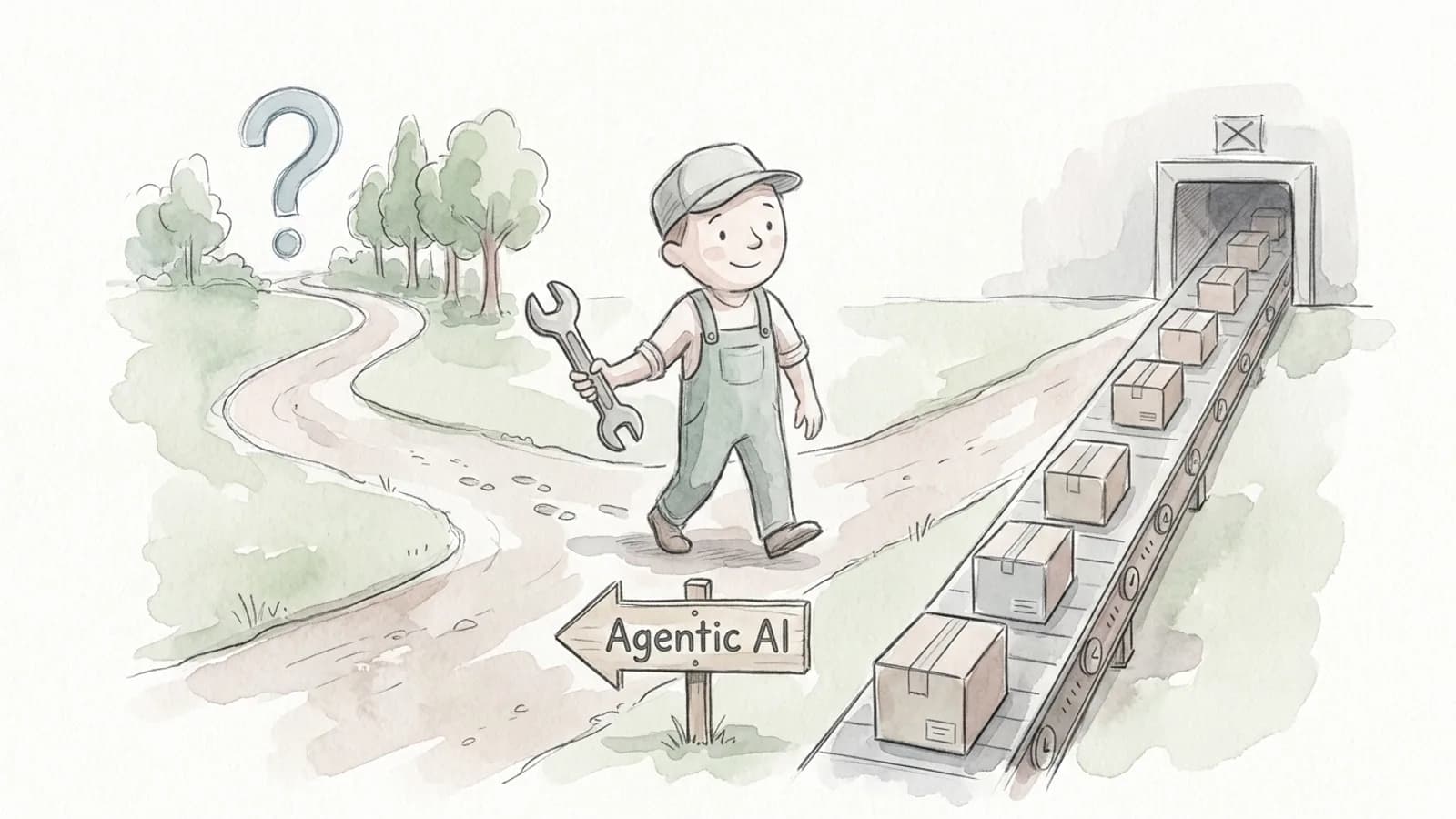
Agentic AI is software in which a language model does more than answer a prompt. It calls tools, takes several steps and acts on what each step returns: it searches, reads, runs code, updates a record. It comes in 2 kinds. In a workflow, your code sets the path and the model does the steps. In an agent, the model decides its own next step from what it has found so far, until the job is done. Use the simplest kind that does the job. Most tasks need a workflow, and only open-ended ones need an agent.
That split comes from Anthropic's guide to building agents, and it is the most useful way to think about the term. "Agentic" is less a product category than a dial: how much of the path the model chooses.
Agentic AI vs generative AI
Generative AI produces something in reply to a prompt: an email, a function, a picture. Agentic AI puts that same kind of model inside a loop. The model reads a goal, chooses an action such as "search for X" or "run the tests", a tool carries it out, and the result goes back to the model for the next decision.
So every agentic system has a language modelLarge Language ModelA model trained on a huge amount of text to predict the next token. Further training turns it into an assistant that follows instructions. at its centre, but most uses of a language model are not agentic. A chatbot that answers from what it knows is generative. The same chatbot, once it can look up your order, issue a refund and email you the receipt, is agentic.
Workflows: the model does the steps, your code sets the path
Anthropic names 5 patterns. Each is an agentic workflowAgentic WorkflowA fixed sequence of model calls and tools that your code controls, such as classify, then look up, then draft. An agent decides its own next steps; a workflow follows the path you wrote.: predictable, testable and cheaper than an agent.
- Prompt chaining. Fixed steps in order, each model call working on the last one's output, with checks in code between them. Draft, check the length, translate.
- Routing. One call classifies the input and sends it down one of a few paths, each with its own prompt and tools. A refund question and a bug report should not share a prompt.
- Parallelization. Independent parts run at the same time and your code joins them, or the same task runs several times and the answers are compared.
- Orchestrator and workers. A model splits the task into parts it decides on, hands each to a worker call and combines the results. The parts vary, but the shape stays the same.
- Evaluator and optimizer. One call writes, another grades the result against criteria, and the first revises until it passes or runs out of tries.
Agents: the model chooses the steps
An AI agentAgentA model that uses tools in a loop, deciding each next step from what the last one returned, until the task is done. runs a loop: look at the goal and what has happened, pick a tool, read the result, repeat. Nobody wrote the path down. That is what lets a coding agent fix a bug it has never seen, because it can open files, run tests and change course when a test fails.
It is also what makes agents slower, dearer and harder to trust. Anthropic says plainly that agentic systems trade latency and cost for better results on hard tasks. An agent can take 30 steps where a workflow takes 3, and every step sends the whole conversation back to the model. It can also take a wrong step on its own. Agents need limits, which stopping runaway agent bills and human approval before risky actions cover.
How to choose: the simplest pattern that works
Start with one model call. If that cannot do it, use a workflow. Use an agent only for the part whose steps depend on what it finds. Answer 4 questions about a job and see where it lands:
Agent. Nobody can list the steps in advance, so the model decides each next step from what the last one found, until it is done or hits a limit.
Pattern names from Anthropic's Building effective agents. Workflows follow a path your code sets; an agent chooses its own steps. Agents trade time and cost for handling the unknown, so use one only where the steps cannot be listed.
The questions do most of the work:
- Can you write the steps down? If they are always the same, chain them. If there are a few known cases, route between them. If they depend on what turns up, you need a model to decide them.
- Do the parts depend on each other? If not, run them in parallel, or let an orchestrator hand them out.
- Can you say what good looks like? Then a second call can grade the first, which beats hoping one call gets it right.
- What does a wrong step cost? Anything that sends, pays, deletes or deploys gets a person's approval, whichever pattern you chose.
Many real systems mix them. A support system routes each ticket, runs fixed workflows for refunds and password resets, and hands only the odd cases to an agent with read-only tools.
What makes agentic AI work in practice
Anthropic lists 3 principles, and they hold for any framework:
- Keep it simple. Every extra step is cost, time and another place to fail.
- Show the plan. An agent that says what it is about to do and why is far easier to debug and to trust.
- Design the tools as carefully as the prompt. A model can only act through its tools. Clear names, clear descriptions, small inputs and useful errors matter more than a clever prompt. The tool useTool UseGiving a model a list of things it can ask to have done, such as search the web or read a file. The model asks; the program around it does the work and hands back the result. concept covers how a model calls them.
Then test it like software. How to evaluate an AI agent shows how to build tests that catch failures before users do. Our free AI engineering course teaches the parts in order, from a single model call to tools and agents.
Questions
- What is agentic AI?
- Agentic AI is software in which a language model does more than produce one answer: it calls tools, takes several steps and acts on what each step returns. It comes in 2 kinds. In a workflow, your code sets the path and the model fills in steps. In an agent, the model decides its own next step from the results so far, until the task is done.
- What is the difference between agentic AI and generative AI?
- Generative AI produces content, such as text, code or images, in response to a prompt. Agentic AI uses a generative model as the decision maker inside a loop that calls tools and acts: it searches, runs code, updates a ticket or sends a message. Every agentic system contains a generative model; most uses of generative AI are not agentic.
- What is the difference between an AI workflow and an AI agent?
- Anthropic defines workflows as systems where models and tools are orchestrated through predefined code paths, and agents as systems where the model dynamically directs its own process and tool use. A workflow is predictable and cheaper; an agent handles tasks whose steps cannot be listed in advance, at the price of more time, cost and risk.
- What are examples of agentic AI?
- A coding agent that reads a repository, runs the tests and fixes what fails; a support system that routes each ticket to a refund, bug or sales path; a research assistant that searches, reads several pages and writes a summary with sources; a data agent that finds why a pipeline failed and opens a fix. The first, third and fourth decide their own steps; the second follows a fixed path.
- When should I use an AI agent instead of a workflow?
- When nobody can list the steps in advance, because each one depends on what the last one found, and when the task is worth the extra time and cost. Anthropic recommends the simplest solution that works: a single model call, then a workflow, and an agent only when the open-ended part cannot be avoided.
Sources