DP-750 vs DP-700: Azure Databricks or Fabric data engineer exam?
Microsoft now has 2 data engineering certifications: DP-750 for Azure Databricks and DP-700 for Microsoft Fabric. Same price, same pass mark, same free yearly renewal, very different skills. What each one tests, line by line, how much of each your current job already covers, and where Databricks' own Data Engineer Associate fits.
Tecyfy · Published · 8 min read
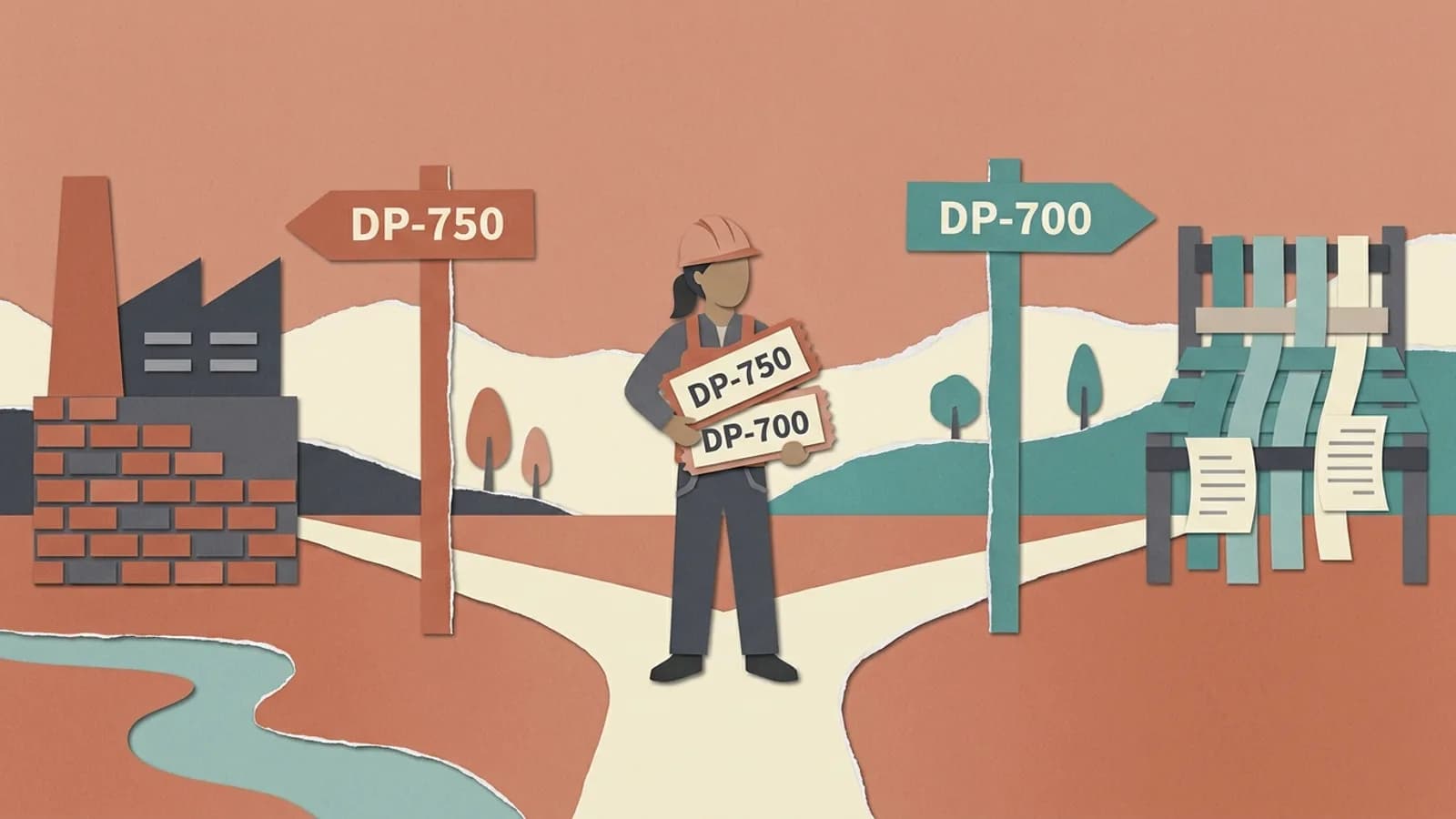
DP-750 is Microsoft's data engineering exam for Azure Databricks, and DP-700 is its data engineering exam for Microsoft Fabric. Take the one for the platform your team runs. They cost the same ($165 in the US), both need 700 out of 1,000 and both renew free every year, but they test different tools, so knowing one helps less with the other than the names suggest.
DP-750 is the newer of the two. Microsoft opened its beta in March 2026 and planned it to go live in May. Both skills outlines were then updated on 19 October 2026, with minor changes, so a study plan from the summer still mostly holds.
The 2 exams side by side
| DP-750 | DP-700 | |
|---|---|---|
| Certification | Azure Databricks Data Engineer Associate | Fabric Data Engineer Associate |
| Platform | Azure Databricks, with Unity CatalogUnity CatalogDatabricks' governance layer: one place that names every table, file volume, model and function as catalog.schema.object, decides who may use each, and records lineage and access. | Microsoft Fabric, with OneLake |
| Price | $165 | $165 |
| Pass mark | 700 | 700 |
| Renewal | Free online assessment each year | Free online assessment each year |
| Sections | 4: setup 15–20%, governance 15–20%, prepare data 30–35%, pipelines 30–35% | 3, each 30–35%: manage, ingest and transform, monitor and optimize |
| Skill lines in the guide | 77 | 54 |
| Languages you code in | SQL and Python | SQL, PySpark and KQL |
| Also expected | Git, Microsoft Entra, Azure Data Factory, Azure Monitor | Fabric items: pipelines, Dataflows Gen2, Eventstream, Eventhouse |
Microsoft's DP-700 page gives 100 minutes and 10 languages. The DP-750 page lists the price and a free practice assessment but, when we read it, no time or language list, so check it when you book.
What DP-750 tests
DP-750 is a Databricks engineer's exam with an Azure frame around it. The 2 heaviest sections are the everyday work: getting data in and shaping it, then running it as jobs.
- Prepare and process data (30–35%): Lakeflow Connect, notebooks,
COPY INTO, CDC feeds, Event Hubs, Structured Streaming and Lakeflow Spark Declarative Pipelines with Auto Loader. Table design sits here too: Slowly Changing DimensionsSlowly Changing DimensionsThe ways a warehouse handles a change to a descriptive record, such as a customer's address: type 1 overwrites it, type 2 adds a new dated version, and type 3 keeps the previous value in an extra column. types, temporal tables, partitioning, liquid clustering and Z-ordering, and managed against external tables. - Deploy and maintain pipelines (30–35%): Lakeflow Jobs with triggers, schedules, alerts and automatic
restarts; Git branches and pull requests; a testing strategy; and Declarative Automation Bundles deployed
with the Databricks CLI or the REST API. Then the troubleshooting: caching, skew, spill and shuffle read
from the Spark UI and query profile, and
OPTIMIZEandVACUUM. - Secure and govern Unity Catalog objects (15–20%): grants, row filters and column masks, attribute-based access control with tags and policies, lineage, audit logs and a secure Delta Sharing design.
- Set up the environment (15–20%): choosing between job, serverless, classic and shared compute, cluster settings, Photon, and creating catalogs, schemas, volumes and foreign catalogs.
The Azure parts are thin but present: Key Vault secrets, managed identities, Azure Data Factory as an ingestion choice, and logs and alerts through Azure Monitor's Log Analytics. If you know Databricks on AWS, those few lines are what you add.
What DP-700 tests
DP-700 is about Fabric's own pieces and when to use each one. Several of its lines start with "choose between": a Dataflow Gen2, a pipeline or a notebook; T-SQL, KQL or PySpark; native tables or OneLake shortcuts in Real-Time Intelligence.
- Implement and manage (30–35%): Spark, domain, OneLake and Apache Airflow workspace settings, deployment pipelines and database projects, and security at every level from workspace to folder, with dynamic data masking, sensitivity labels and OneLake security.
- Ingest and transform (30–35%): full and incremental loads, mirroring and shortcuts, a dimensional model, and streaming with Eventstream, Spark Structured Streaming or KQL, windowing functions included.
- Monitor and optimize (30–35%): this is the section that surprises people. It names an error to resolve for each item type (pipelines, Dataflows Gen2, notebooks, Eventhouse, Eventstream, T-SQL, shortcuts) and an optimization for each engine. A third of the exam is running Fabric, not building on it.
KQL is the clearest dividing line. DP-700 expects you to write it; DP-750 never mentions it.
How much of each one your job already covers
Every skill line of both study guides is counted below under the task it belongs to. Pick what you do at work:
- Not yet: table and model design (15 lines), such as catalogs, SCD, partitions, liquid clustering
- Not yet: permissions and governance (13 lines), such as Unity Catalog grants, ABAC, row filters, lineage
- Not yet: monitoring and tuning (17 lines), such as errors in each item, optimize every engine
- Not yet: streaming and KQL (8 lines), such as Eventstream, Eventhouse, KQL, windowing
Take DP-750 (Azure Databricks). Your platform decides it: you already do 25% of its skill lines, and the rest is work you will meet there anyway. Start with table and model design, then permissions and governance.
Every skill line in Microsoft's DP-750 and DP-700 study guides (skills as of 19 October 2026), counted under one task each. Lines are not questions: Microsoft weights the sections.
The pattern is clear even before you click. DP-750 puts more than a third of its lines on governance and table design, where Databricks engineers who only write notebooks are weakest. DP-700 puts close to a third of its lines on monitoring and tuning, where engineers who build but do not run Fabric are weakest. A line is not a question, and Microsoft weights the sections rather than the lines, but it shows where the reading is.
DP-750 or Databricks' own Data Engineer Associate?
If you work on Azure Databricks, there are 2 exams for the same work. Databricks Certified Data Engineer Associate is Databricks' exam for any cloud: 45 questions in 90 minutes for $200, valid 2 years, renewed by a paid exam. DP-750 costs $165, adds the Azure pieces, and renews free each year on Microsoft Learn.
- Choose DP-750 if you work for a Microsoft partner or an employer that counts Microsoft certifications, or you will stay on Azure.
- Choose Databricks' exam if you may work on Databricks on AWS or Google Cloud, or your employer is a Databricks partner. Our guide to every Databricks certification has the full list.
The syllabi overlap heavily (Lakeflow, Unity Catalog, bundles, Spark troubleshooting), so the second exam costs little extra study.
Moving from Synapse or from DP-203
DP-203, the old Azure Data Engineer exam, retired on 31 March 2025, and our DP-203 piece covers that change. Its holders split 2 ways now. If your Synapse work is moving to Fabric, DP-700 is the successor. If it is moving to Azure Databricks, DP-750 is.
For the hands-on side of DP-750's biggest sections, the data engineering course runs every step on Databricks Free Edition or local PySpark.
Questions
- What is the difference between DP-750 and DP-700?
- DP-750 earns the Microsoft Certified: Azure Databricks Data Engineer Associate and tests building pipelines on Azure Databricks: compute, Unity Catalog governance, data processing, and Lakeflow Jobs with Git and bundles. DP-700 earns the Fabric Data Engineer Associate and tests Microsoft Fabric: workspaces and OneLake security, pipelines and Dataflows Gen2, Real-Time Intelligence with KQL, and monitoring and optimizing every Fabric engine. Both cost $165 in the US and need 700 to pass.
- Should I take DP-750 or DP-700?
- Take the one for the platform your team runs or is moving to: DP-750 for Azure Databricks, DP-700 for Microsoft Fabric. The exams share less than their titles suggest: DP-750 spends most of its weight on Unity Catalog, table design and Lakeflow jobs, DP-700 on Fabric's own items, KQL streaming and troubleshooting each engine.
- Is DP-750 harder than DP-700?
- Neither has a published pass rate, and both are intermediate associate exams that need 700 out of 1,000. DP-750 is narrower in tools but deeper in Databricks: it lists 77 skills against DP-700's 54 and expects SQL, Python, Git, Microsoft Entra, Azure Data Factory and Azure Monitor. DP-700 is wider in tools, adding KQL, T-SQL, Eventstream and Dataflows Gen2.
- How much does the DP-750 exam cost?
- Microsoft lists DP-750 at $165 USD, priced by the country where the exam is taken, the same as DP-700. The certification expires each year and is renewed by passing a free online assessment on Microsoft Learn. Microsoft also offers a free practice assessment for it.
- Is DP-750 the same as the Databricks Certified Data Engineer Associate?
- No. DP-750 is Microsoft's exam about Azure Databricks, for $165, renewed free every year. Databricks Certified Data Engineer Associate is Databricks' own exam for any cloud: 45 questions in 90 minutes for $200, valid 2 years and renewed by a paid exam. They cover much of the same platform, so one prepares you well for the other.
- When did DP-750 come out?
- Microsoft announced the Azure Databricks Data Engineer Associate in early 2026, with the DP-750 beta exam and training from March 2026 and the exam expected to go live in May 2026. Its skills outline was last updated on 19 October 2026, with minor changes to data modelling in Unity Catalog and to development lifecycle processes.
Sources
Where each fact comes from
- 1Study guide for Exam DP-750: Implementing Data Engineering Solutions Using Azure Databricks
- 2Study guide for Exam DP-700: Implementing Data Engineering Solutions Using Microsoft Fabric
- 3Microsoft Certified: Azure Databricks Data Engineer Associate
- 4Microsoft Certified: Fabric Data Engineer Associate
- 5Course DP-750T00-A: Implement data engineering solutions using Azure Databricks
- 6The AI job boom is here. Are you ready to showcase your skills?
- 7Microsoft Certified: Azure Data Engineer Associate (retired)
- 8Databricks Certified Data Engineer Associate