Claude Opus 5.5 vs Sonnet 5.5 vs Haiku 5.5: which to use
Opus 5.5 costs twice as much as Sonnet 5.5 and 40 times as much as Haiku 5.5, yet on Epoch AI's index Opus and Sonnet score within each other's range of doubt. What each model is for, the differences in thinking and limits that matter in code, a worked month for each, and how to route work so most tokens go to the cheapest model that passes.
Tecyfy · Published · 8 min read
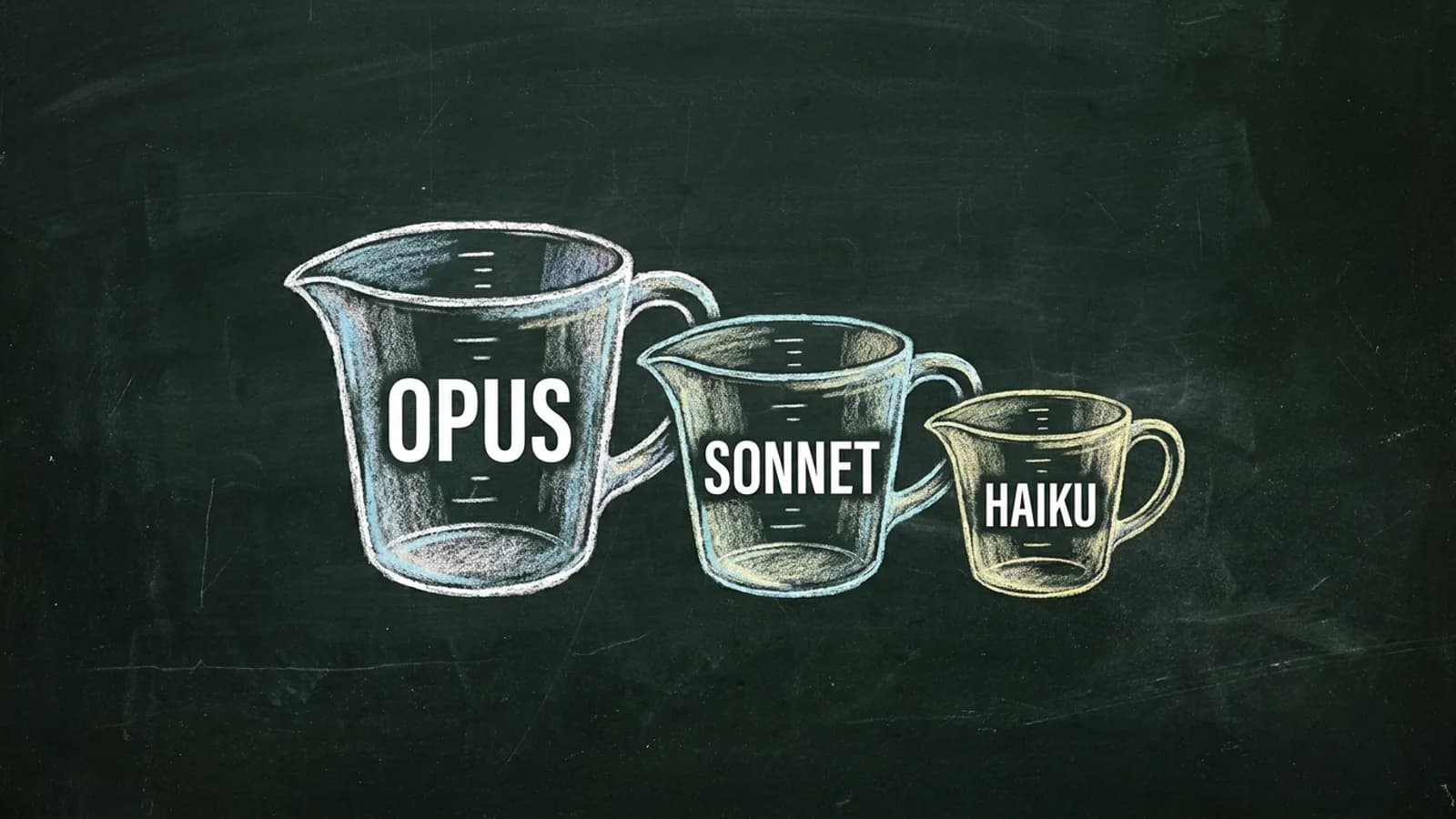
Use Claude Sonnet 5.5 by default, Claude Haiku 5.5 for high-volume simple work, and Claude Opus 5.5 only where your own tests show Sonnet falls short. Opus costs $4 and $20 per million input and output tokens, Sonnet $2 and $10, Haiku $0.10 and $0.50, and on Epoch AI's capability index Opus and Sonnet are within each other's range of doubt.
All 3 have the same 1 million token context window, 128,000 output tokens and June 2026 knowledge. What differs is price, speed, a few controls, and how they behave on long, hard tasks.
Side by side
| Opus 5.5 | Sonnet 5.5 | Haiku 5.5 | |
|---|---|---|---|
| Built for | Long-running agentic coding and knowledge work | Speed and intelligence together | High volume, low latency: classify, extract, route |
| Input / output per million | $4 / $20 | $2 / $10 | $0.10 / $0.50 ($0.50 / $2.50 over 100K input) |
| Cache read | $0.20 (5%) | $0.10 (5%) | $0.01 (10%) |
| Speed (Anthropic's label) | Moderate | Fast | Fastest |
| Default effort | medium | high | medium |
| Thinking off? | No, always on | Lowest is between_tools | Yes, at high effort or below |
| Epoch Capabilities Index | 166.8 | 164.5 | 159.0 |
| Retires no sooner than | 22 Sep 2027 | 28 Sep 2027 | 7 Oct 2027 |
Scores are from the Epoch Capabilities Index by Epoch AI (CC BY 4.0), which combines over 50 benchmarks. Opus's 90% range runs from 163.5 to 171.0 and Sonnet's from 161.4 to 168.3, so a general benchmark cannot tell them apart. Haiku's 159.0 is lower but well above GPT-5's 150, and above Claude Sonnet 4.5's 146.8. Each model's page has the details: Opus 5.5, Sonnet 5.5, Haiku 5.5.
What each is for
Sonnet 5.5 is the everyday model: code generation, data analysis, writing, tool-using agents. Its default effort is high, so lowering effort is the first way to make it faster and cheaper before you switch models.
Haiku 5.5 is for the many small calls: labelling tickets, pulling fields out of documents, choosing which tool or model handles a request, summarising, and sub-agent tasks inside a larger agent. Anthropic suggests starting here and upgrading only where tests show a gap. Two cautions: requests over 100,000 input tokens cost 5 times as much, and the same text counts about 30% more tokens than on Haiku 4.5, so recount before comparing bills.
Opus 5.5 is for work that runs for hours: autonomous coding across a large codebase, big refactors, complex systems work. On a short question it is usually slower and dearer for the same answer.
Differences that break code
The 3 models do not take the same requests:
- Thinking. Opus 5.5 always thinks; a request with
thinking: {"type": "disabled"}returns a 400 error. Sonnet 5.5 also rejectsdisabledand offersbetween_toolsas its lowest setting. Haiku 5.5 still acceptsdisabled. On all 3, set depth witheffort, not a token budget. - Forced tool use.
tool_choiceofanyortoolreturns a 400 error on Opus 5.5 and Sonnet 5.5. Useautowith strict tool schemas instead. - Sampling.
temperature,top_pandtop_kare rejected, as our article on their removal explains.
So "just swap the model ID" is not always safe. Run your eval set on each candidate.
A worked month
A product search assistant: 50,000 requests a day (1.5 million a month), 3,000 input tokens and 500 output tokens each.
- Opus 5.5: 1.5 million × (3,000 × $4 + 500 × $20) ÷ 1 million = $33,000
- Sonnet 5.5: 1.5 million × (3,000 × $2 + 500 × $10) ÷ 1 million = $16,500
- Haiku 5.5: 1.5 million × (3,000 × $0.10 + 500 × $0.50) ÷ 1 million = $825
Now route: a Haiku call (or a simple rule) decides whether a request is easy. If tests show Haiku handles 70% well, send those to Haiku and the rest to Sonnet: 0.7 × $825 + 0.3 × $16,500 = $5,528, a third of all-Sonnet. Thinking tokens are billed as output, so lower effort on the easy share saves more again.
1,500,000 requests a month: $33,000 on Opus, $16,500 on Sonnet, $825 on Haiku. Sending 70% to Haiku and the rest to Sonnet costs $5,528.
Claude API list prices from Anthropic's pricing page; cache and thinking tokens left out (thinking is billed as output). Scores are the Epoch Capabilities Index by Epoch AI (CC BY 4.0); Opus and Sonnet overlap within their ranges of doubt.
Combine them
Anthropic describes 2 patterns that put most tokens on a cheaper model:
- Orchestrator and workers. A strong model plans and checks; Haiku sub-agentsSubagentAn agent started by another agent for one part of a task. It works in its own fresh context and returns only its findings. do the bulk reading and extraction.
- Executor and advisor. A cheaper model does the work and asks a stronger one only at hard decisions.
Either way, the bill follows the model that reads the most tokens, so put the cheap model there. Prompt caching cuts the rest: cache reads are 5% of the input price on Opus and Sonnet. The prompt caching calculator prices your prompt on each model, and which model finds the cheapest model that scores as well as you need.
What to do
- Start new work on Sonnet 5.5; try lower effort before a smaller model.
- Move high-volume, well-defined steps to Haiku 5.5 once tests pass.
- Reserve Opus 5.5 for long agentic jobs where Sonnet fails your tests.
- Re-run the comparison at each release: the gaps between tiers keep shrinking.
Questions
- What is the difference between Claude Opus, Sonnet and Haiku?
- They are 3 sizes of the same generation. Opus 5.5 is built for long-running agentic coding and knowledge work, Sonnet 5.5 for the best mix of speed and intelligence, Haiku 5.5 for high-volume, latency-sensitive work such as classification, extraction and routing. All 3 have a 1 million token context window and 128,000 output tokens.
- How much do Claude Opus 5.5, Sonnet 5.5 and Haiku 5.5 cost?
- Per million tokens on the Claude API (22 October 2026): Opus 5.5 $4 input and $20 output, Sonnet 5.5 $2 and $10, Haiku 5.5 $0.10 and $0.50 (rising to $0.50 and $2.50 for requests over 100,000 input tokens). Batch requests are half price, and cache reads cost 5% of the input price on Opus and Sonnet and 10% on Haiku.
- Is Claude Opus 5.5 better than Sonnet 5.5?
- On Epoch AI's Capabilities Index Opus 5.5 scores 166.8 and Sonnet 5.5 164.5, and their 90% confidence ranges overlap, so a general benchmark cannot separate them. Anthropic positions Opus for multi-hour autonomous coding and complex systems work. Test both on your own tasks; for most, Sonnet at half the price does as well.
- Is Claude Haiku 5.5 good enough for production?
- For classification, extraction, routing, summaries and sub-agent tasks, often yes: it scores 159 on Epoch AI's index, above GPT-5's 150, at a twentieth of Sonnet's price. Anthropic suggests starting with Haiku and upgrading only where your tests show a gap.
- Can I turn thinking off on Claude 5.5 models?
- Not on Opus 5.5, where adaptive thinking is always on and effort controls its depth. On Sonnet 5.5 the lowest setting is thinking type between_tools. Haiku 5.5 still accepts disabled at high effort or below. On all 3, forced tool use (tool_choice any or tool) returns a 400 error.
Sources