Amazon Bedrock vs SageMaker AI: which one you need
Bedrock rents ready-made models by the token; SageMaker AI rents the machines to train and host your own by the hour. Which to choose for calling Claude, serving an open model, fine-tuning and classic machine learning, where AgentCore fits, and the traffic at which an endpoint becomes cheaper than paying per token.
Tecyfy · Published · 7 min read
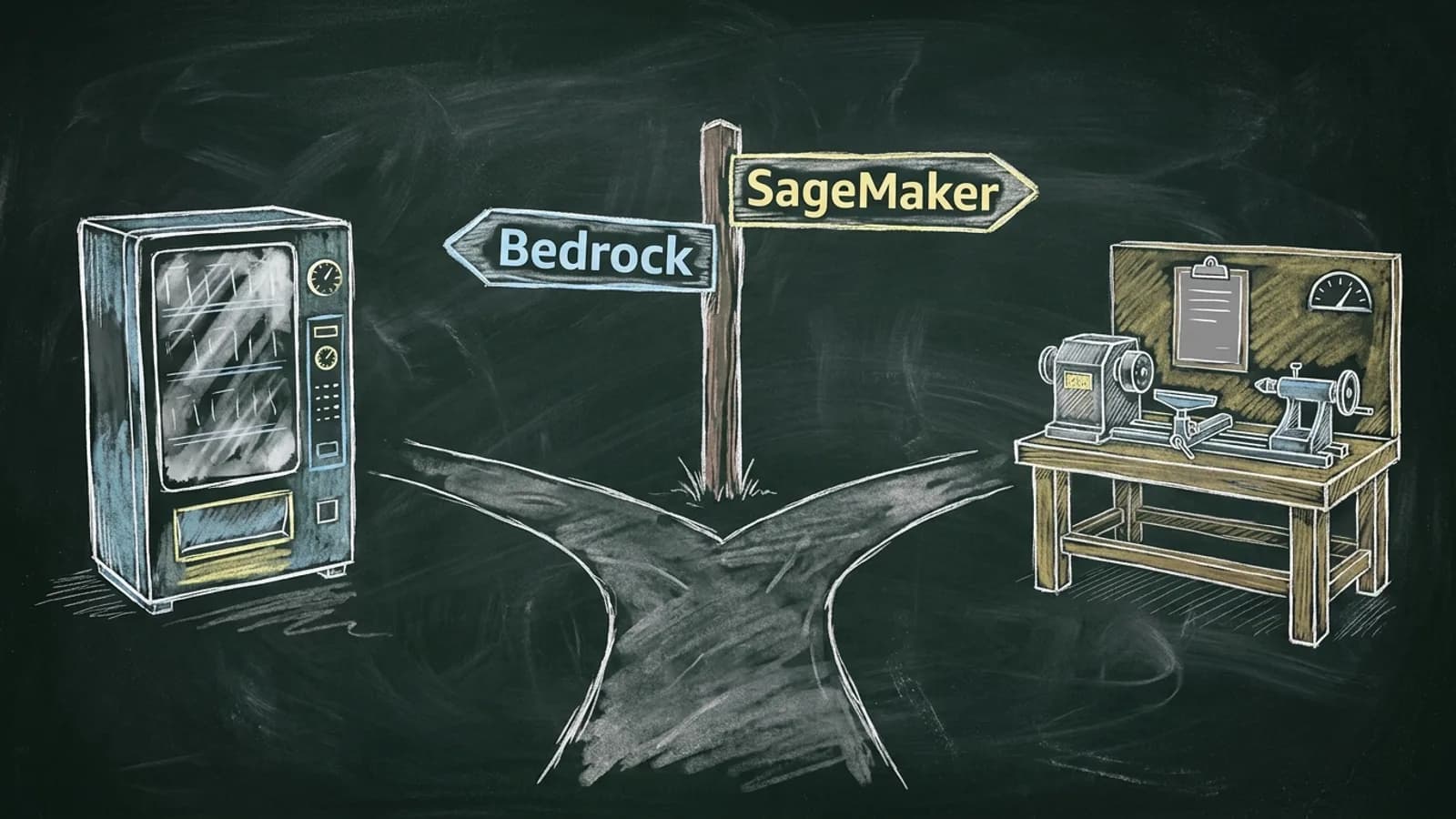
Amazon Bedrock rents ready-made models by the token; Amazon SageMaker AI rents the machines to train and host your own models by the hour. If you want to call Claude, Nova or a popular open model from an app, use Bedrock. If you need to train a model, fine-tune one in depth, or serve a model Bedrock does not offer, use SageMaker AI.
Most teams building with GenAI on AWS need only Bedrock. The cases for SageMaker AI are real but narrower, and the bill works differently: Bedrock costs nothing when no one is asking, a SageMaker AI endpoint costs the same every hour it is up.
The difference in one table
| Amazon Bedrock | Amazon SageMaker AI | |
|---|---|---|
| What you get | An API to foundation models | Notebooks, training jobs, endpoints you size |
| Models | Anthropic, Amazon, Meta, Mistral, DeepSeek, Gemma and others | Any model you can put in a container; JumpStart hub of open models |
| Claude | Yes | No |
| Billing | Per token (or reserved capacity) | Per instance-hour, used or not |
| Scaling | AWS's problem, within your quota | Yours: instance type, count, autoscaling |
| Idle cost | None | Every hour the endpoint runs |
| Fine-tuning | Some models, few settings | Many open models, full control |
| Classic ML (forecasting, fraud, tabular) | No | Yes |
The Amazon BedrockAmazon BedrockAWS's managed service for calling AI models from many makers, Anthropic, OpenAI, Amazon, DeepSeek and others, through one API inside your AWS account, with AWS permissions, logs and billing. concept page explains the parts of Bedrock; this article is about choosing.
Situation by situation
You want Claude or another frontier model in your app. Bedrock. SageMaker AI cannot host Claude. Whether to use Bedrock or Anthropic's API directly is its own question, covered in Claude on Bedrock or the Claude API.
You want an open model such as Llama, Qwen or gpt-oss. Bedrock first, if it lists the model: Llama 3.2 11B costs $0.16 per million tokens and Llama 3.3 70B $0.72, with nothing to run. SageMaker AI when Bedrock does not have the model or version you need, when you need a GPU type of your choice, or when traffic is high and steady enough to keep an instance busy (the numbers are below).
You want to fine-tune. For a supported model and a simple job, Bedrock's customization is quicker, but serving the result needs Provisioned Throughput by the hour. SageMaker AI's serverless model customization fine-tunes models from the gpt-oss, Gemma, Llama, Nemotron and Qwen families, and since 21 October 2026 lets you set the sequence length. You can then bring the weights back to Bedrock with Custom Model Import. Read Fine-TuningFine-TuningTraining an existing model a little further on your own examples so it picks up a task, a format or a style. Often a good prompt does the job first. and LoRALoRAA way to fine-tune a model by freezing its weights and training 2 small matrices beside each chosen layer, so a task needs a tiny file instead of a full copy of the model. first; most teams find that retrieval or a better prompt is enough.
You need classic machine learning. Forecasting, fraud scoring, recommendations on your own tables: SageMaker AI. Bedrock does not train those models.
You are building an agent. Bedrock AgentCore runs agents in production (runtime, memory, tool gateway, identity), with any model. Our AgentCore guide covers it. SageMaker AI only enters if the agent calls a model you host there.
When an endpoint becomes cheaper
A real-time SageMaker AI endpoint bills by the instance-hour. AWS's own example uses ml.g5.2xlarge (one NVIDIA A10G with 24 GB) for a 7B model, at $1.52 an hour in US East (N. Virginia). Run 2 for availability all month: 2 × 730 × $1.52 = $2,219.
The same traffic on Bedrock, using Llama 3.2 11B at $0.16 per million tokens:
- 20 million tokens a day: 600 million a month = $96
- 200 million a day: $960
- Break-even: $2,219 ÷ $0.16 per million ÷ 30 days = about 460 million tokens a day
Below that, every endpoint hour is partly paid for nothing. Above it, the endpoint wins only if 2 instances can actually serve 460 million tokens a day, about 5,300 a second, which depends on the model, request length and the serving stack. Measure before you buy. Our GPU memory calculator tells you whether a model fits a GPU at all.
At 20 million tokens a day, Bedrock costs about $96 a month and the endpoint $2,219. The endpoint only pays off above 462 million tokens a day, and only if its 2 instances can serve that many.
Defaults: Llama 3.2 11B on Bedrock at $0.16 per million tokens, and ml.g5.2xlarge at $1.52 an hour in US East (N. Virginia), from AWS's pricing pages. Office hours is 12 hours on 22 days. Whether one instance keeps up depends on the model and the length of each request; measure it.
Two more options sit between the two. SageMaker AI Serverless Inference scales to zero, but runs on CPU with at most 6 GB of memory and no GPUs, so it does not suit language models. Bedrock Custom Model Import serves your own weights with no idle cost: billed in 5-minute windows while active, scaled to zero after 5 idle minutes, with a cold start of tens of seconds. An 8B model needs 2 Custom Model Units at $0.157 a minute, $9.42 an hour, so it pays off for weights you must use but call only part of the day.
What to do
- Start on Bedrock. Price the job on our cost calculator and the Bedrock pricing guide.
- Move a model to SageMaker AI only when Bedrock lacks it or your steady traffic is above the break-even, measured, not guessed.
- Fine-tune on SageMaker AI when you need control; serve the result where it costs least for your traffic.
- Keep classic ML on SageMaker AI and GenAI calls on Bedrock; most companies end up using both.
Questions
- What is the difference between Amazon Bedrock and SageMaker AI?
- Bedrock is a serverless API to foundation models from Anthropic, Amazon, Meta, Mistral and others, billed per token, with no servers to run. SageMaker AI is a platform to build, train and host your own machine learning models on instances you choose and pay for by the hour. Use Bedrock to call a model; use SageMaker AI to own one.
- Can I run Claude on SageMaker?
- No. Claude models run on Amazon Bedrock (or Anthropic's own API), not on SageMaker AI endpoints. SageMaker AI hosts open-weight models such as Llama, Qwen, Gemma or gpt-oss, and your own models.
- Is SageMaker cheaper than Bedrock?
- Only at high, steady traffic. A SageMaker AI endpoint bills every hour it runs, used or not. With 2 ml.g5.2xlarge instances at $1.52 an hour (about $2,200 a month), a small open model on Bedrock at $0.16 per million tokens stays cheaper until roughly 460 million tokens a day, and only then if the endpoint can serve that many.
- Should I fine-tune on Bedrock or SageMaker AI?
- Bedrock fine-tunes a few supported models with little setup and then needs Provisioned Throughput to serve the result. SageMaker AI fine-tunes many open models, serverless or on instances you choose, and lets you host the result anywhere, including back on Bedrock through Custom Model Import.
- Where does Bedrock AgentCore fit?
- AgentCore is the part of Bedrock for running agents in production: a runtime, memory, a gateway for tools, identity and observability. It works with any model, on Bedrock or elsewhere. It is not a replacement for SageMaker AI, which is about models, not agents.
Sources