When an AI model is retired: a migration checklist
Every model maker retires old models, and on retirement day requests to them fail. How much notice Anthropic, OpenAI, Amazon Bedrock and Azure give, how to find every caller, and the 7 steps that turn each forced move into a small, tested change.
Tecyfy · Published · 8 min read
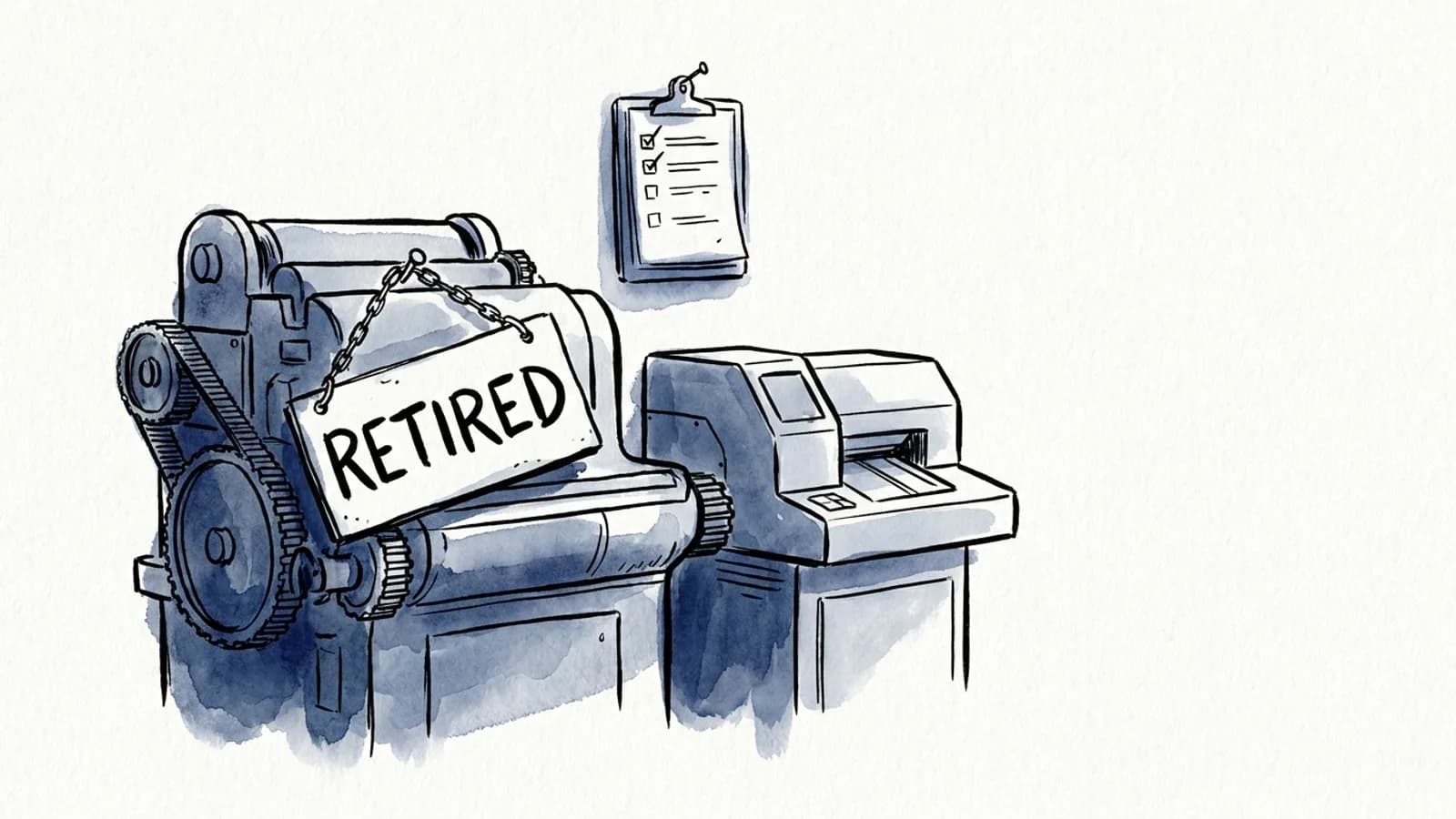
When a model is retired, every request to it fails, so each retirement is a deadline for every app that still calls it. Makers give notice first: at least 60 days at Anthropic, at least 6 months for OpenAI's generally available models, usually 6 months on Amazon Bedrock and at least 60 days on Azure, and the move is safe only if you can prove the replacement does your job as well.
Retirements are now routine. In 2026 alone Anthropic retired Claude Opus 4, Sonnet 4 and Opus 4.1 and set Sonnet 4.5 to go on 30 November; OpenAI set GPT-4o and GPT-4.1 to shut down on 14 January 2027. The teams that move calmly are the ones that treat it as a repeatable job, not an emergency.
The words makers use
- Active: supported and recommended.
- Legacy: no more updates; deprecation will follow. On Bedrock, Legacy is already the countdown.
- Deprecated: still works, has a retirement date and a named replacement.
- Retired (or shut down, or end of life): requests fail.
The Model DeprecationModel DeprecationThe notice that a model will be switched off on a set date. Until then it still answers; after its retirement date, every request to it fails, so code must move to a newer model first. concept page covers the idea; here is how much time each platform gives.
How much notice you get
| Platform | Minimum notice | Notes |
|---|---|---|
| Anthropic (Claude API) | 60 days for public models | Dates also apply to Claude Platform on AWS and Microsoft Foundry |
| OpenAI | 6 months GA, 3 months for variants (chat, Codex), as little as 2 weeks for previews | Fine-tuned models retire with their base |
| Amazon Bedrock | Legacy period of 6 months for most models, 45 days for some | Its own dates; existing users can lose access after 15 idle days |
| Azure (Foundry) | 60 days GA, 30 days preview | Standard deployments auto-upgrade unless told not to |
Two traps hide in that table. Bedrock's dates are not the maker's: Claude on Bedrock follows the date on the Bedrock model card, and a Legacy model you have not called for 15 days can disappear for you early. Azure upgrades for you: a Standard deployment moves to the replacement version at retirement, which keeps it running but changes the model under your prompts without a test. Set versionUpgradeOption deliberately; provisioned deployments never auto-upgrade and must be moved by hand.
The checklist
- Find every caller. On the Claude API, export the Console's Usage page: the CSV splits usage by API key and model. On Bedrock, search CloudTrail or invocation logs for the model ID. Then search code and configuration for the ID, including fine-tuned models built on it and scheduled jobs that run once a month.
- Name one owner and a date. Put the retirement date minus 2 weeks in the calendar as your own deadline.
- Keep an eval set. 100 to 300 real inputs with what a good answer looks like, scored automatically where possible. Our guide on how to evaluate an AI agent shows how to build one; the eval sample size calculator tells you whether a score change is real or noise.
- Run old and new side by side. Same inputs, same settings. Read the replacement's migration notes: parameters get removed (Claude 5.5 models no longer take
temperature, as our temperature article explains), output gets longer or shorter, and token counts change with a new tokenizer. - Fix prompts, then re-run. Change one thing at a time. Most regressions are format and length, not reasoning.
- Canary. Send 5% of real traffic to the new model, compare error rates, cost per request and user feedback for a few days, then 100%.
- Switch, keep a way back, then delete. Keep the old model ID in configuration until retirement day, then remove it so nothing calls it by accident.
Using a model ID with a date (claude-sonnet-4-5-20250929) rather than an alias means nothing changes until you choose; it also means you must choose before the date.
Anthropic gives at least 60 days. Starting after 14 days, a 6-week migration finishes with 4 days to spare.
Minimum notice from Anthropic's, OpenAI's, AWS's and Microsoft's lifecycle pages; a maker can give more, and can give less for a safety or compliance reason. Step lengths are a typical split of the work.
A worked example
A team runs a support summariser on Claude Sonnet 4.5: 1 billion input tokens and 100 million output tokens a month, $3,000 + $1,500 = $4,500. Sonnet 4.5 retires on 30 November 2026; the named replacement is Sonnet 5.5, at $2 and $10 per million: $2,000 + $1,000 = $3,000, a third less, if the token counts stay the same.
Token counts rarely stay the same. Say the eval run on 200 saved conversations shows the new summaries are 20% longer. Output becomes 120 million tokens and the bill $3,200: still cheaper, but not by as much as the price list says. A one-line length instruction brings it back. Without the eval set, the team would have found out from the invoice. The full Sonnet move is in our Sonnet 4.5 retirement guide.
Make the next one smaller
- Read model IDs from configuration, never from code.
- Keep the eval set in the repository and run it on every model change, not only forced ones.
- Log the model ID on every request, so finding callers is a query.
- Watch the deprecation pages, or our what changed digest, which lists retirements as they are announced.
- Compare prices before you switch on our price tables: the named replacement is not always the cheapest model that passes.
Questions
- What happens when an AI model is retired?
- Requests to it fail. Before that, the model is deprecated: it still works, but the maker has set a retirement date and named a replacement. Anthropic, OpenAI, AWS and Microsoft all email the accounts still using a model and publish the dates on a deprecations page.
- How much notice do model makers give before retiring a model?
- On 22 October 2026: Anthropic at least 60 days for publicly released models; OpenAI at least 6 months for generally available models, 3 months for specialised variants and as little as 2 weeks for preview models; Amazon Bedrock a Legacy period of 6 months for most models, 45 days for some; Azure at least 60 days for GA models and 30 for previews. All can shorten it for safety or compliance reasons.
- Does Amazon Bedrock retire Claude models on the same date as Anthropic?
- Not necessarily. Bedrock's lifecycle dates are its own and can differ from the model maker's; for Bedrock only the date on the Bedrock model card applies. Once a Bedrock model enters its Legacy period, new customers cannot start using it and existing customers can lose access after 15 days without using it.
- Will Azure upgrade my model deployment automatically?
- Standard, Data Zone Standard and Global Standard deployments are upgraded automatically at retirement unless you set versionUpgradeOption to NoAutoUpgrade, in which case the deployment stops working. Provisioned deployments are never upgraded automatically; you must migrate them yourself.
- How do I find which applications still use a deprecated model?
- On the Claude API, export the Usage page in the Claude Console: the CSV breaks usage down by API key and model. On Bedrock, search CloudTrail or the model invocation logs for the model ID. Then search your code and configuration for the model ID, including fine-tuned models built on it.
Sources