Do ChatGPT, Claude and Gemini watermark your text?
Yes. Claude marks text worldwide, the Gemini app has marked it since 2024, ChatGPT and Codex are getting it in the EU, and the Grok API from 7 November 2026. The mark is in the choice of words, you can't check for it yourself, and a match proves much less than most people think.
Tecyfy · Published · 10 min read
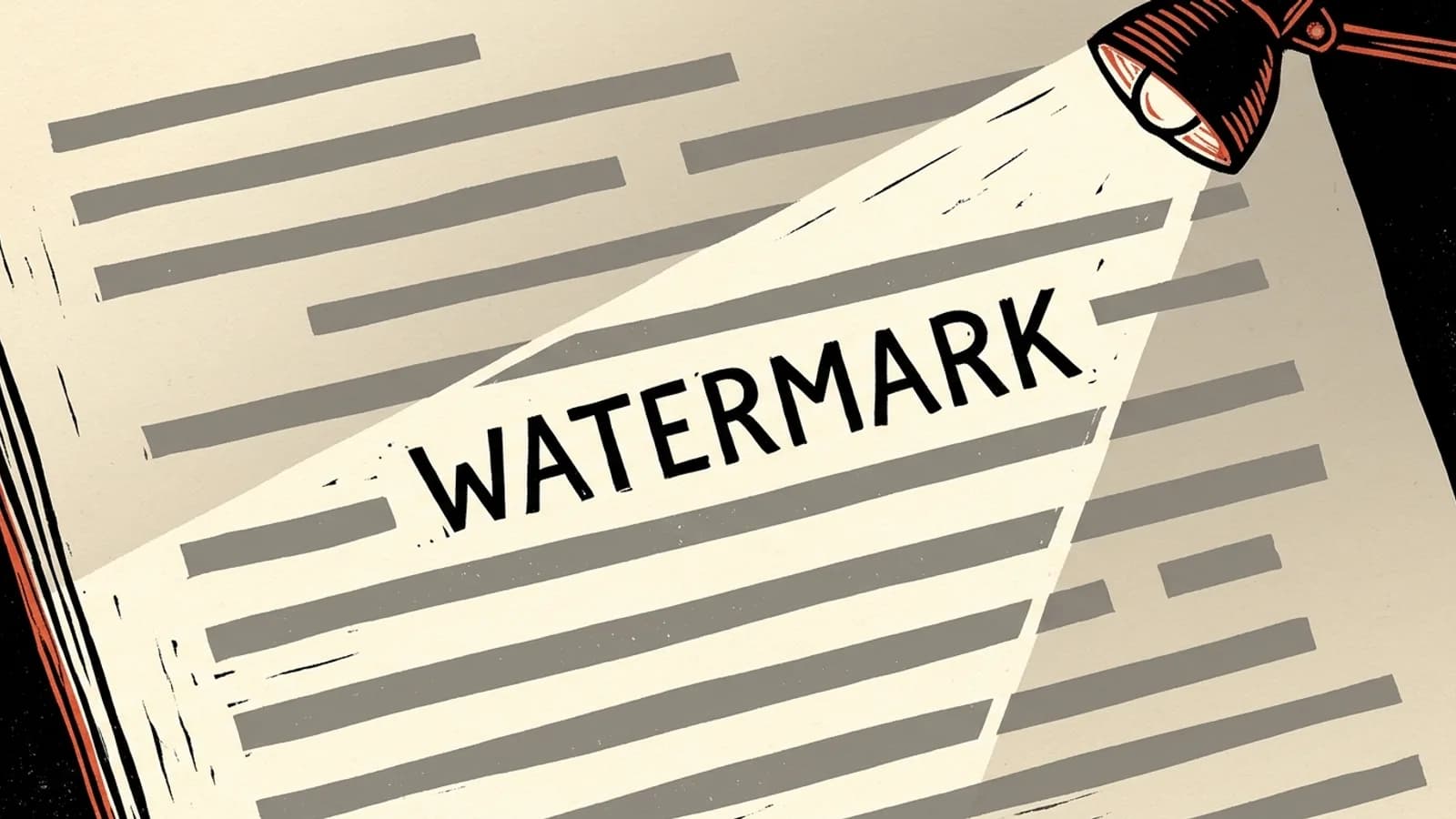
Yes, most of them now do. Claude marks its text worldwide, the Gemini app has marked text since 2024, OpenAI is rolling a mark out to ChatGPT and Codex in the EU, and the Grok API turns one on by default from 7 November 2026. You won't see it, because the mark is in which words the model picked. You can't test for it either, and even the makers' own detectors prove much less than most people assume.
We made the short version as a video. Watch it on YouTube, or play it here:
 Watch this part · 2:22Your AI Text Has a Hidden Watermark (ChatGPT, Gemini, Claude)
Which AI tools watermark their text?
Claude, Gemini, ChatGPT in the EU and the Grok API all do, and they differ in where the mark applies and who can test for it.
| Tool | Is its text marked? | Who can test for the mark |
|---|---|---|
| Claude | Yes, worldwide, on the models in Anthropic's list, including on AWS, Google Cloud and Microsoft Foundry | Eligible organisations, in private preview |
| Gemini app | Yes, with SynthID | Google's public detector takes images, video and audio. We found no public check for text |
| ChatGPT and Codex | In the EU only, for eligible text, on all plans | Approved research and academic organisations |
| OpenAI API | Off by default. Customers anywhere can opt in | The same. Opting in gives no detector access |
| Grok API | On by default from 7 November 2026, for 7 models | By application |
| Meta AI, Microsoft Copilot | Both companies signed the EU's code, but we found no statement from either that their chatbots mark text | Not applicable yet |
If you're in the US, the answer depends on the tool. Claude's text is marked there, because Anthropic says it has no durable way yet to limit the mark by region. OpenAI says ChatGPT's mark is not a global default at launch.
How can a watermark hide in ordinary words?
It hides in choices that were random anyway. A model writes one tokenTokenThe small piece of text a language model reads and writes, often part of a word. Prices, limits and the context window are all counted in tokens. at a time, and at each step it has a list of candidates. Take "The weather today was cold and...". "Sugary" is out, but "overcast" and "grey" are about equally good, so chance decides between them. That chance is what temperatureTemperatureA setting that controls how much chance goes into each word a model picks. Low gives focused, predictable answers; high gives more varied ones. turns up and down, and how AI writes goes through it step by step.
A watermark replaces the source of that chance. Instead of a plain random number, a secret key and the last few words settle the pick.
The weather today was cold and …
- overcast
- grey
- sugary
- No watermark
- The model keeps the words that fit, and a random number settles which one it writes.
- With a watermark
- The same words stay in the running, but the secret key and the last few words settle the pick instead of a random number.
- Detector, later
- With the same key, it works out at each word what the pick should have been, then counts how often the text agrees. Chance explains a few agreements. It does not explain a long run of them.
Our drawing of the example in Anthropic's explainer, with no real model scores behind it. Source: Anthropic, How Claude's text watermark works.
Anthropic compares it to a board game where you stop rolling dice and read the moves from a book of the digits of pi. The game plays the same and nobody at the table can tell, but anyone who knows pi can look back over the moves and see which game it was.
3 things follow from this, and they explain nearly everything else on this page.
There is nothing to find by looking. Anthropic and OpenAI both say the mark adds no hidden characters, so pasting the text into a plain editor doesn't clean it, and a tool that hunts for odd characters is looking for the wrong thing. Anthropic says the mark travels with the text when you copy it.
The mark needs choices. Where only one answer is right, the watermark has nothing to act on. Anthropic's example is "Isaac Newton's most famous work was called Principia...", where the next word has to be "Mathematica". So plain facts, short answers and code carry little of it.
Each maker has its own key. Claude's key tells you nothing about text from Gemini, and OpenAI built a separate method called textGrain, while Claude's mark is a version of Google's SynthID Text. An AI watermarkAI watermarkA hidden pattern a maker puts in what its model generates, so a detector holding the right key can later tell that the model was likely involved. can only ever answer a question about one maker's model.
Can an AI watermark be traced back to you?
No, according to the makers. Anthropic says the mark carries no information about you, your organisation or your chats, and OpenAI says it does not identify a person, account, prompt or conversation. The mark says something about a model. You have to take that on their word, though, as nobody outside can inspect the live systems.
Does a watermark make the answers worse?
The evidence says no, for ordinary prose. Google ran about 20 million Gemini answers, with and without the mark, and the thumbs-up rate differed by 0.01% and the thumbs-down rate by 0.02%, both too small to count as real differences. OpenAI reports no meaningful difference across its benchmarks.
Those are the makers grading themselves, so one outside test is worth reading. A 2026 paper ran the open-source version of SynthID Text on 2 open-weight models, and on prose the effect was no larger than changing the random seed. On code it cost 3 points of correctness on one model and too little to measure on the other. That tests the open version, because no public tool can test the live products.
Why are AI companies watermarking text now?
Because EU law now requires a mark. Article 50 of the EU AI Act says AI-generated text, images, audio and video must be marked in a machine-readable format, with fines of up to €15 million or 3% of worldwide turnover. We cover who owes what in our guide to Article 50, so here is only how the dates fell.
EU stepMaker's move
- Oct 2024Google's Nature paper says SynthID Text is marking Gemini answers.
- Jun 2026The European Commission publishes the Code of Practice on marking AI content.
- Jul 2026About 190 organisations have signed the code by the end of the month, Anthropic, Google, Meta, Microsoft and OpenAI among them.
- 2 Aug 2026Article 50 of the EU AI Act applies. New systems must mark what they generate.
- Aug 2026Anthropic explains how Claude's watermark works and why it applies worldwide.
- 5 Oct 2026OpenAI opens opt-in marking in its API and says ChatGPT and Codex in the EU follow within weeks.
- 3 Nov 2026Claude Mythos 5, Opus 4.7 and Sonnet 4.6 start carrying the mark.
- 7 Nov 2026The mark goes on by default for 7 Grok API models.
- 2 Dec 2026Last day for systems that were on the market before 2 August.
The rules also explain where the mark is thin. The Code of Practice doesn't ask for a watermark on text under 200 tokens, which OpenAI puts at about 150 words of English, and OpenAI says that covers code snippets too. The Commission says the marking duty doesn't apply when a system only assists with standard editing. Our token counter shows which side of the 200-token line your text falls on.
Can you check your own text for an AI watermark?
No. The detectors stay with the makers and the groups they approve. Anthropic's is in private preview for organisations such as regulators, media, fact-checkers, independent researchers and educational bodies. OpenAI's goes to research and academic organisations, and xAI takes applications.
So a free site that offers to read a ChatGPT or Claude watermark doesn't have what it needs. Anthropic says outright that AI detection companies don't have its key. Whatever those sites report comes from something else.
3 other kinds of tool get mixed up with this:
- AI detectors such as Pangram judge the writing itself, looking for habits that AI text tends to show. No key is involved, and it is a different kind of evidence.
- File checkers read marks in files such as pictures, not in words. That covers Claude Content Checker, openai.com/verify and Google's SynthID Detector.
- Open-source SynthID Text runs in Hugging Face Transformers, where you set your own keys and train your own detector. It is for marking your own model's output, and it won't read Gemini's mark.
The EU's code tells signatories to make detection free of charge, so this answer may change. For now, you can't test your own text.
How reliable is AI watermark detection?
It works well on long, untouched text and falls away quickly on anything else. The fullest numbers we found are OpenAI's, for its own textGrain, so read them as one maker's results and not as a figure for every watermark.
Length comes first. A 200-token passage is about 150 words, and 400 tokens about 300.
- 200 tokens80%
- 400 tokens95%
Share of watermarked passages OpenAI's detector found, on content such as psychology, with the detector set to a target false positive rate of 1%. OpenAI gives both figures as "about". Source: OpenAI, Our approach to EU text provenance rules.
Those are good conditions. OpenAI says the rate is substantially lower for content such as mathematics, where the model has less freedom in its wording.
Editing is the bigger effect. In a 300-word passage, 10% is 30 words, a light edit by anyone's standard, and it took about a quarter of the marked passages out of reach. OpenAI reports this as its own evaluation, which is why it starts at about 92% and not 95%.
- No words changed92%
- 10% swapped66%
- 25% swapped17%
Share of 400-token watermarked passages OpenAI's detector still found after words were replaced with synonyms. OpenAI gives each figure as "about". Source: OpenAI, Our approach to EU text provenance rules.
Anthropic and Google describe the same shape in words: light edits usually leave the mark in place, and a thorough rewrite badly weakens it or takes it out. Translation is the odd case. When Claude translates something, every word is its own choice, so the translation carries Claude's mark. Run marked text through something else, and OpenAI says translation can make its mark undetectable.
Then there's language. This test used different prompts from the charts above, so compare the languages with each other and not with those.
Detection rateAdded by a stronger watermark
- Spanish69%
- Portuguese68%
- English68%
- Dutch68%
- Estonian67%
- Croatian66%
- French62%
- German61%
- Czech61%
- Slovenian61%
- Swedish61%
- Finnish60%
- Danish60%
- Irish59 to 64%
- Slovak56 to 64%
- Polish55 to 65%
- Italian54 to 64%
- Lithuanian54 to 62%
- Hungarian53 to 64%
- Maltese52 to 62%
- Latvian52 to 64%
- Bulgarian43 to 56%
- Greek43 to 54%
- Romanian42 to 59%
OpenAI's test of 500 prompts across the 24 official EU languages, at a 1% false positive rate. OpenAI states Spanish (69.0%) and Romanian (42.2%) in words; we measured the other bars on its chart and rounded to the nearest point. Source: OpenAI Help Center, Provenance signals in OpenAI-generated content.
OpenAI raised the strength for the languages under 60%, and the second shade on each bar shows what that gained. Even so, at this setting a Greek passage is found a little over half the time.
What does a watermark match actually prove?
Very little, and much less than an accusation needs. A match means a model was likely involved at some point. A miss means nothing at all.
| The detector says | What you can say | What you can't say |
|---|---|---|
| Mark found | That maker's model likely generated or processed some of this text | Who wrote it, how much the model wrote, whether it was only an edit, whether the text is true |
| No mark found | Very little | That a person wrote it. The text may be short, edited, translated, older than the watermark, from an unsupported model or from another company's tool |
Those limits come from the makers' own explanations. OpenAI goes further and lists checking student work, such as essays and theses, as outside the scope of its detector programme.
Even a good false-positive rate looks different at scale. OpenAI's tests aimed for 1%, which sounds tiny until you put names on it.
About 5 flagged anyway495 correctly passed
Our sum, using the 1% target in OpenAI's tests. OpenAI rules out checking student work with its detector. The point is what 1% looks like across a year group.
If someone tells you a tool has proved your work was written by AI, ask which tool. If it's a style-based detector, it isn't reading a watermark. If it claims to be a watermark check, ask how it got the maker's key. Either way, a score alone can't show how a piece of work was made, and your drafts and notes speak to that better than any detector can.
Can an AI text watermark be removed?
It can be weakened, as the charts above show, and a complete rewrite removes it, in Anthropic's words. We're not going to walk through that. A "remover" asks you to trust a result you have no way to test, since you have no detector to run the text through afterwards. It also buys less than it sounds like: no mark was never proof that a person wrote anything, and text rewritten that heavily is your rewrite anyway.
What changes if you build on these APIs?
Mostly nothing in your code, but each maker asks for something different.
On Claude, you don't change requests or response handling. The one catch is Claude Sonnet 4.6: set temperature, top_p or top_k to a non-default value and the text might not carry the mark, so leave all 3 out if you rely on it, including any your framework sets. We covered those settings in the end of temperature on Claude.
On OpenAI, the mark is yours to switch on, in project or organisation settings under Allow text watermarking, for the models you pick. Turning it on gives you no detector, so you can't test your own output.
On Grok, it's on by default on every API endpoint, and it covers structured outputs and tool call arguments as well as plain text. Read the x-watermark response header to see whether a reply was marked. Only a team admin can opt out, and doing so means confirming that a legal exception applies to your use.
A watermark also doesn't replace a label. OpenAI says so directly, and Anthropic tells anyone deploying Claude to work out for themselves what Article 50 asks of their product. If you publish AI text to inform the public on matters of public interest, the visible disclosure duty sits with you, as our Article 50 guide explains.
Questions
- Does ChatGPT watermark text?
- In the EU, yes. OpenAI is adding an invisible watermark called textGrain to eligible ChatGPT and Codex text there, and said in October 2026 that it is not a global default at launch. Outside the EU, ChatGPT text is not marked by default. API customers anywhere can opt in.
- Does Claude watermark text in the US?
- Yes. Anthropic applies the watermark worldwide, because it says it does not yet have a durable way to limit it by region. It works at the model level, so it is there on the supported models in Claude's own products and on AWS, Google Cloud and Microsoft Foundry.
- Does Gemini watermark text?
- Yes. Google's SynthID watermarks text from the Gemini app and web experience, and its 2024 paper in Nature said it was already marking Gemini answers.
- How do I check if my text has an AI watermark?
- You can't, today. The detectors for Claude, ChatGPT and Grok text go only to organisations that apply and are approved, and Google's public SynthID Detector takes images, video and audio. A free website does not hold the makers' keys, so it is not reading their marks.
- Can an AI text watermark be removed?
- It can be weakened. OpenAI found that replacing 10% of the words in a 400-token passage cut detection from about 92% to 66%, and 25% cut it to 17%. Anthropic says a complete rewrite removes the mark. No match proves nothing either way, so a clean result would not show that a person wrote the text.
- Can an AI watermark be traced to me?
- No, according to the makers. Anthropic says the mark carries no information about you, your organisation or your chats, and OpenAI says it does not identify the person, the account, the prompt or the conversation.
- Do AI watermarks prove someone used AI to cheat?
- No. A match means a model was likely involved at some point, with no word on how much of the text it wrote or what the person did. No match does not prove a person wrote it. OpenAI lists checking student work as outside the scope of its detector programme.
- Is an AI watermark the same as an AI detector?
- No. An AI detector such as Pangram judges text by patterns in the writing and needs no key. A watermark detector looks for a signal a maker put in on purpose, and it needs that maker's secret key.
Sources
Where each fact comes from
- 1How Claude's text watermark works
- 2How Claude marks AI-generated content
- 3Text watermark
- 4API release notes
- 5Our approach to EU text provenance rules
- 6Provenance signals in OpenAI-generated content
- 7Output Watermarking
- 8Scalable watermarking for identifying large language model outputs
- 9SynthID
- 10Google expands SynthID Detector for AI content
- 11SynthID: tools for watermarking and detecting LLM-generated text
- 12Watermarks Without Verification: AI Text Watermarking After the EU AI Act
- 13Article 50: Transparency obligations
- 14Transparency obligations under Article 50 of the AI Act
- 15Strong backing for the Code of Practice on Transparency of AI-generated Content
- 16Code of Practice on marking and labelling of AI-generated content