Mistral Large 4: open weights, price, licence and benchmarks
Mistral released the weights of Mistral Large 4, nicknamed Le Chonk, on 29 October 2026: a 1-trillion-parameter mixture-of-experts model with 52 billion active, a 1M-token context and 3 reasoning modes, at $0.70 input and $2.10 output per million tokens on Mistral's API. What the licence lets you do, what its benchmarks claim, and what running it yourself takes.
Tecyfy · Published · 7 min read
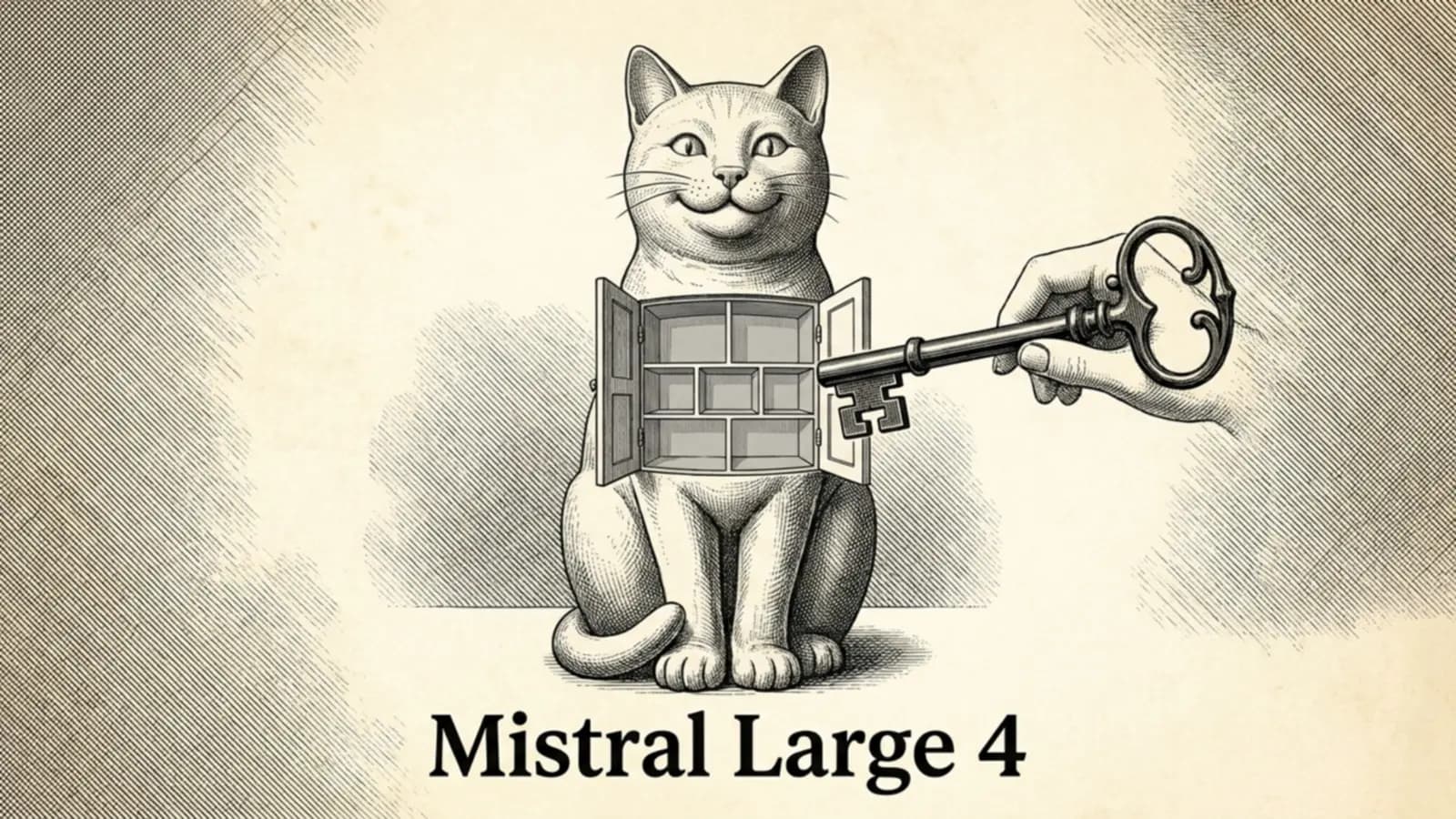
Mistral Large 4 is Mistral's largest model, and since 29 October 2026 its weights are openOpen-Weight ModelA model whose trained weights anyone can download and run on their own hardware, under a licence that sets what you may do with them. Open weights alone do not make a model open source.: a mixture-of-experts model of about 1 trillion parameters, 52 billion of them active for each token, that reads text and imagesMultimodal ModelA model that works with more than one kind of input or output, such as text and images, or text, sound and video, instead of text alone., holds 1 million tokens of context and writes text. Mistral calls it Le Chonk. On Mistral's API it costs $0.70 per million input tokens and $2.10 per million output tokens, and the weights can be downloaded from Hugging Face and run on your own hardware under a licence with one condition.
A first version came out in public preview on 6 October. The 29 October release is that model after 3 more weeks of reinforcement learning, which Mistral says mainly improved coding and defensive security work.
Mistral Large 4 at a glance
| Mistral Large 4 | |
|---|---|
| Parameters | 1.05 trillion in total; 49 billion active per token, 52 billion with embeddings and output layers |
| Design | Mixture of ExpertsMixture of ExpertsA neural architecture that routes tokens through different expert subnetworks.: 128 routed experts, 4 active per token, plus 1 shared expert |
| Input and output | Text and images in, text out; a 1.6-billion-parameter vision encoder |
| Context WindowContext WindowEverything a model can see at once while it writes an answer, counted in tokens. When the window is full, something has to be left out. | 1 million tokens |
| Reasoning modes | Low, Medium, High (the default) |
| Languages | More than 160, including every official EU language |
| API names | mistral-large-4, mistral-large-4-0 |
| API price | $0.70 input, $0.07 cached input, $2.10 output, per million tokens |
The 3 reasoning modes are new in the open release. Low is for simple tasks and replaces the old None mode, Medium is for everyday work, and High, the default, is for the hardest jobs and agent runs. Set it per request with reasoning_effort. Mistral recommends a temperature of 1.0 and top_p of 0.95 in every mode.
What the licence allows
The weights come under the Mistral Ecosystem Open-Weight License, a modified MIT licence. It lets anyone use, copy, change, fine-tuneFine-TuningTraining an existing model a little further on your own examples so it picks up a task, a format or a style. Often a good prompt does the job first., publish and sell the model, and build on it, for free. The one condition is about one kind of business.
If you, or a company you are affiliated with, run a Model as a Service business, you need a separate commercial licence from Mistral before using the model commercially. The licence defines that as giving a third party access to the model for inference or further training, through an API or hosted endpoints for example, in a way that lets them meaningfully control the inputs, parameters or training data.
In practice that splits users like this:
- Free with no extra licence: running it inside your own company where no outside party gets access; building a product where the model sits behind specific features; passing requests on to a model someone else hosts; using it through Mistral's own products.
- Needs a commercial licence from Mistral: an inference API or hosted endpoint that lets customers send their own prompts and settings to the model, or fine-tune it.
Price and where to use it
Mistral sells it on its API from $0.70 per million input tokens and $2.10 per million output tokens, with cached input at $0.07. It is also in Mistral Studio, on OpenRouter, on NVIDIA-hosted endpoints and in an NVIDIA NIM container, and on Microsoft Foundry with private deployment options for Azure. Mistral's coding agent, Vibe, runs on it too.
Against other large models people use for agents and coding, at each maker's listed standard price:
| Model | Input per million | Output per million |
|---|---|---|
| Mistral Large 4 | $0.70 | $2.10 |
| DeepSeek V4 Pro (peak hours) | $1.32 | $3.96 |
| Kimi K3.1 Pro | $2 | $10 |
| Claude Opus 5.5 | $4 | $20 |
A low price per token does not settle the cost of a job: a model that thinks longer or needs more turns uses more tokens. Price your own workload in the LLM cost calculator and see every current model on our price tables.
Benchmarks, as Mistral reports them
All the numbers below come from Mistral's release post and model card. Mistral says a full technical report is still to come, so read them as the maker's claims until others repeat them.
- Coding agents: 48% on the Artificial Analysis Coding Agent Index, which Mistral calls effectively tied with GLM-5.3, the leading open-weight model there, while using 47% fewer tokens per task on average.
- Terminal work: 41% on Terminal-Bench 4.0, 13 points above the preview, with 30% fewer output tokens.
- Code quality: 19.7% on Cognition's private FrontierCode 2.0, which checks whether a maintainer would merge the agent's change; Mistral says that leads.
- Human preference: in Surge's blind side-by-side tests on code, graders preferred it over GLM-5.3, Kimi K3 and DeepSeek V4.1 Flash; only Claude Opus 5.5 ranked above it among the models tested.
- Security: 51% on the Artificial Analysis Cyber Index, which measures finding, reproducing and patching vulnerabilities, and a 96.6% average refusal rate on malicious cyber requests.
- General intelligence: 26 on the Artificial Analysis Intelligence Index v5, which Mistral says is the highest among western open-weight models; it also says the leading Chinese open-weight models score higher.
Mistral also writes that it saw the model's potential to help real attacks in live traffic during the preview, and that it is changing its guardrails and will keep updating them.
Running Mistral Large 4 yourself
This is not a model for one GPU. The weights on Hugging Face are stored in FP8FP8An 8-bit floating-point number format, in 2 kinds, E4M3 and E5M2. It halves a model's memory against BF16, and in tests it matched 16-bit results., and the 54 files of the checkpoint add up to about 1,061 GB. A separate NVFP4 checkpoint, which targets NVIDIA Blackwell GPUs and which Mistral says performs the same, is about 610 GB. Spread across the 8 GPUsTensor ParallelismSplitting each layer's weight matrices across several GPUs, so every GPU does part of every layer and they combine their results after each one. that Mistral's examples use, that is about 133 GB a GPU in FP8 and about 76 GB in NVFP4 for the weights alone, before the memory each conversation's KV CacheKV CacheWork a model saves from the text it has already read, so it is not redone for every new token. Prompt caching keeps that work between requests and charges less for it. takes.
Mistral recommends vLLMvLLMAn open-source engine for serving language models fast, built on PagedAttention, that answers requests through the same kinds of API the big model makers offer., with its own Docker image:
docker run --runtime nvidia --gpus all \
  -v ~/.cache/huggingface:/root/.cache/huggingface \
  -p 8000:8000 --ipc=host \
  vllm/vllm-openai:mistral-large-4 \
  --model mistralai/Mistral-Large-4-1T-A52B \
  --tensor-parallel-size 8 \
  --tool-call-parser mistral \
  --reasoning-parser mistral \
  --enable-auto-tool-choice \
  --gpu-memory-utilization 0.85
The 2 parser flags are needed for tool calls and to keep the reasoning apart from the answer. The checkpoint also carries a small draft model for speculative decodingSpeculative DecodingA small, fast drafter guesses the next few tokens and the large model checks them all in one pass, keeping the ones it agrees with. Answers come faster and stay exactly the same., which Mistral calls DSpark; adding --speculative-config '{"method": "dspark", "num_speculative_tokens": 3}' gave up to 1.9 times the throughput in Mistral's tests without changing the output. SGLang, transformers and llama.cpp (through GGUF files) can serve it as well, and Axolotl, Unsloth and TRL can fine-tune it.
If your own serving falls short, Mistral's model card itself suggests using its API. For how vLLM compares with a desktop runner, see vLLM vs Ollama; for the memory a model needs on a given GPU, our GPU memory calculator does the sums for the open models it lists.
Questions
- Is Mistral Large 4 open source?
- Its weights are open: since 29 October 2026 anyone can download them from Hugging Face. The licence, the Mistral Ecosystem Open-Weight License, is a modified MIT licence that allows use, changes, fine-tuning and selling, for free, with one condition: a business that runs a Model-as-a-Service offering needs a separate commercial licence from Mistral before using the model commercially.
- How much does Mistral Large 4 cost?
- On Mistral's API it costs $0.70 per million input tokens, $0.07 per million cached input tokens and $2.10 per million output tokens. The weights themselves are free to download and run on your own hardware.
- How big is Mistral Large 4?
- About 1 trillion parameters in total (1.05 trillion by Mistral's model card), of which 52 billion are active for each token, including embeddings and output layers. It is a mixture-of-experts model with 128 routed experts, 4 of them active per token, plus 1 shared expert, and a 1.6-billion-parameter vision encoder.
- What is Le Chonk?
- Le Chonk is Mistral's nickname for Mistral Large 4, its largest model, used in the release post and on the Hugging Face model card. It was first released in public preview on 6 October 2026, and its improved version's weights came out on 29 October 2026.
- What hardware do I need to run Mistral Large 4?
- A lot. The FP8 checkpoint on Hugging Face is about 1,061 GB of files and the NVFP4 version, which targets NVIDIA Blackwell GPUs, about 610 GB. Mistral's serving examples use 8 GPUs with tensor parallelism in vLLM or SGLang. If local serving falls short, Mistral recommends its own API.
- Is Mistral Large 4 on OpenRouter?
- Yes. Besides Mistral Studio and the Mistral API, it is on OpenRouter as mistralai/mistral-large-4-0, on NVIDIA-hosted endpoints and on Microsoft Foundry, and the open weights are on Hugging Face.