ChatGPT vs Claude vs Gemini for work: which to use
ChatGPT, Claude and Gemini all cost about $20 a month, and their top models score level on Epoch AI's capability index. What separates them at work is what the $20 buys, whether your chats train their models, and which office suite each one lives in. The 3 compared on those, with a week-long test to settle it on your own work.
Tecyfy · Published · 9 min read
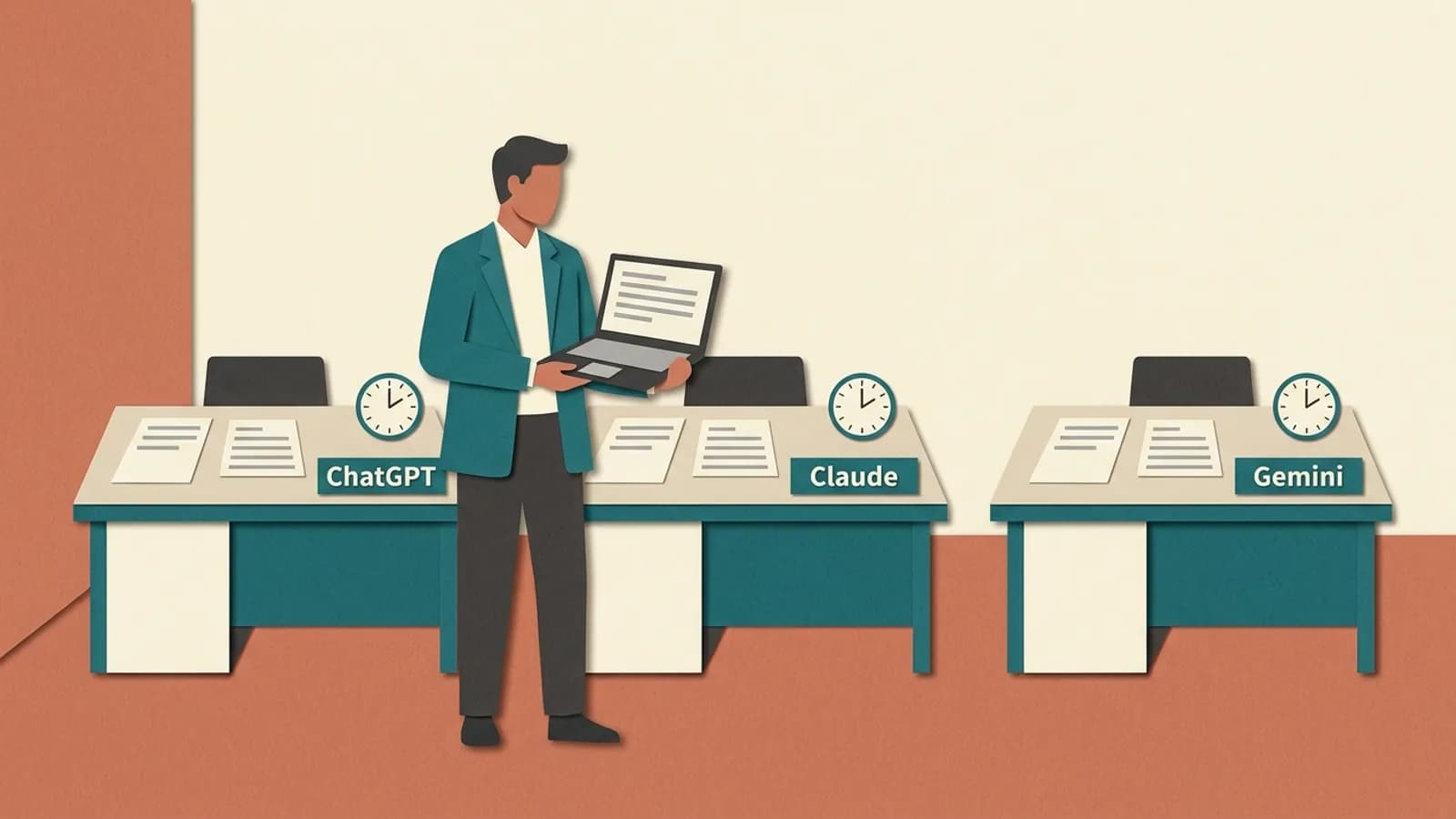
For most work, the right choice between ChatGPT, Claude and Gemini is the one that sits inside the apps you already use, because the 3 are closer than their fans admit. The paid plans all cost about $20 a month, and their top models score level on Epoch AI's independent capability index. What differs is what each $20 buys, whether your chats can train the model, and how far each reaches into Microsoft 365 or Google Workspace.
So this is not a "which AI is smartest" piece. It compares the 3 as a tool you would pay for and put your work into, on the plans and rules their makers published in October 2026, and ends with a way to settle it on your own tasks in a week.
Is one of them clearly smarter?
No. On Epoch AI's Capabilities Index, which folds over 50 benchmarks into one score, GPT-6 Astra and Claude Opus 5.5 both score 169 and Gemini 4 Argon 166 (read 30 October 2026, data under CC BY 4.0). Each score comes with a 90% range 7 to 9 points wide, and the 3 ranges overlap, so the index cannot put them in order. OpenAI's GPT-6.1 Sol scores 168, level with its own flagship.
That does not mean they answer alike. One writes the email you would send and another needs 2 rewrites; one reads a 200-page contract without losing the thread and another summarises the first half well. Those differences are real but they depend on the task, which is why the last section of this article is a test rather than a ranking. The flagship comparison covers the 3 top models through the API, where price per token decides.
What does the $20 plan get you on each?
Each maker's $20 plan unlocks its top model, a coding agent and its research mode; they part ways on context, office apps and how the limits work.
| On the $20 plan | ChatGPT Plus | Claude Pro | Google AI Pro |
|---|---|---|---|
| Price | $20 a month | $20 monthly, $17 billed yearly | $19.99 a month |
| Top models | GPT-6 Astra, GPT-6.1 Sol | Opus 5.5, Sonnet 5.5 | Gemini 4 Argon |
| Longest input | 256,000 tokens on reasoning models (about 320 pages); 54,000 on Instant | Up to 1 million tokens, depending on model | 1 million tokens |
| Coding agent | Codex | Claude Code | Entry limits in Google Antigravity |
| Office apps | Excel, Word, PowerPoint and Google Sheets extensions | Claude for Microsoft 365 and Outlook, Claude in Chrome | Gemini in Gmail, Docs and Vids |
| Also in the plan | Image creation, projects, scheduled tasks, custom GPTs | Research, memory, projects, connectors | 5 TB of Google storage, Deep Research, video creation |
| How limits are stated | "Limits apply" | At least 5 times Free per 5-hour window, plus weekly limits | 4 times the Free plan's limits |
The Context WindowContext WindowEverything a model can see at once while it writes an answer, counted in tokens. When the window is full, something has to be left out. row matters most for document work. A context window is how much text the model can read at once, counted in TokenTokenThe small piece of text a language model reads and writes, often part of a word. Prices, limits and the context window are all counted in tokens.s, and a token is about three quarters of an English word. ChatGPT Plus's 54,000-token Instant window holds roughly 40,000 words, enough for a long report but not a set of contracts; its reasoning models take 256,000. Claude and Gemini both offer up to a million, though on Claude it depends on which model you pick.
These are the apps' limits, and the plan sets them, not the model. Through the API the window can differ; GPT-6 Astra's is on its price page. Every model's API window is on the context window chart.
None of the 3 states a message count, and that is the row to read twice. Claude's help page explains that use is measured by the length and complexity of each conversation, the model and the features, with a rolling 5-hour window, weekly limits on top, and Claude Code drawing from the same pool as chat. On Claude, long chats with large files run out sooner than short questions. Why Claude Code eats your limit shows how fast an agent spends it.
Will my work chats be used to train their models?
On the personal plans, yes, until you turn it off; on the team plans, no. That one line is the most important difference between a $20 personal plan and a $25 team seat.
| Plan | Trains on your chats by default? | How to stop it |
|---|---|---|
| ChatGPT Free, Go, Plus, Pro | Yes | Data Controls, or "do not train on my content" in OpenAI's privacy portal; Temporary Chat is never used |
| Claude Free, Pro, Max | Opt-out, so yes unless you turn it off | Privacy settings; Incognito chats are never used |
| Gemini (personal Google Account) | Yes while Keep Activity is on, and some chats are read by human reviewers | Turn Keep Activity off; temporary chats are not used to train |
| ChatGPT Business, Claude Team, Gemini Enterprise | No | Nothing to change |
Two details are easy to miss. Google keeps chats that human reviewers have read for up to 3 years, even if you delete your activity, so a confidential paste made while Keep Activity was on cannot be fully taken back. And pressing thumbs up or down sends the whole conversation as feedback, even with training turned off: Anthropic keeps feedback for up to 5 years, and Google uses it to improve Gemini even when Keep Activity is off. Anthropic also says raw content from connectors, such as files read from Google Drive, is left out of training unless you paste it into the chat.
If your employer has not bought a team plan, check its rules before putting client data into any personal plan.
Which one fits the tools your work already lives in?
Choose by the suite your company runs on, because an assistant that reads your mail and files without copy and paste is used every day, and one in another tab is not.
If your work is in Google Workspace, Gemini is the natural fit. Google AI Pro puts Gemini inside Gmail, Docs and Vids, and the business edition, Gemini Enterprise, connects to Workspace and to Microsoft 365, HubSpot and Jira. Google AI Pro itself needs a personal Google Account, so a company Workspace account gets Gemini through the business plans instead.
If your work is in Microsoft 365, ChatGPT and Claude both reach into it. ChatGPT Plus has extensions for Excel, Word and PowerPoint (and Google Sheets); Claude Pro has Claude for Microsoft 365 and for Outlook. Microsoft's own Copilot is the 4th option here and is outside this comparison.
If the work is code, every $20 plan now carries a coding agent: Codex, Claude Code, or Google Antigravity. The agent is where the limits bite first, because on Claude, for example, coding and chat draw from one pool of usage.
What does a team plan add, and what does it cost?
A team plan adds the training guarantee, shared billing and admin controls, at about $25 a person a month.
| ChatGPT Business | Claude Team | Gemini Enterprise Business | |
|---|---|---|---|
| Standard seat | $20 a user a month yearly, $25 monthly | $20 a seat yearly, $25 monthly | From $21 a seat a month |
| Heavier seat | Premium, $100 yearly or $125 monthly, higher use of ChatGPT Work and Codex, no 5-hour limit | Premium, $100 yearly or $125 monthly, 5x Standard's use | Standard and Plus editions, from $30 |
| Team size | At least 2 seats | 2 to 150 seats | Up to 300 seats |
| Trains on your content | No | No, by default | No |
ChatGPT Business lets one workspace mix the 2 seat types, and Claude Team sells both, so the few people who live in the tool get the $100 seat and everyone else the standard one. Above these sit the enterprise plans. Claude Enterprise is $20 a seat a month, billed yearly for at least 20 seats, plus usage at API rates, so its bill moves with use. How much does AI cost sets the plans against paying per token.
When is the API a better buy than any of the 3 apps?
When the work is a job run many times rather than a person chatting, such as tagging a thousand support tickets or pulling fields out of invoices. Through an API you pay per token, and a small model like Claude Haiku 5.5 costs $0.10 per million input tokens on prompts up to 100,000 tokens, a fraction of a cent a call. A chat plan is made for a person at a keyboard, not for a script sending thousands of requests.
For that choice, which model to use starts from the job and lists the cheapest model that scores high enough, and compare puts any 2 models side by side, such as Claude Opus 5.5 vs GPT-6 Astra.
How to choose in a week
Run the same 3 real tasks from your own week through each assistant's free plan, then pay for the one that did your work best. A benchmark tells you which model is generally strong; only your own tasks tell you which one writes your kind of document.
Pick tasks that differ: one long document to read and question (a contract, a report, a spec), one piece of writing you would send under your name, and one job with numbers or code. Give each assistant the same files and the same words. Judge the results on 3 things: how many corrections each answer needed, whether it invented anything you had to check, and whether it kept to your format. Before pasting anything confidential, turn off training on the free plans (the table above says where) or use a temporary or incognito chat. Even then, Google still uses chats to protect its users, with help from human reviewers, so keep truly confidential material out of personal plans.
The free plans do not carry the top models, so the test is a fair start, not a final verdict. If 2 come out close, let the office suite decide, and if your team needs the training guarantee, buy the team plan rather than 5 personal ones.
Questions
- Is ChatGPT, Claude or Gemini better for work?
- None is better at everything. Their top models, GPT-6 Astra, Claude Opus 5.5 and Gemini 4 Argon, score within each other's range of doubt on Epoch AI's Capabilities Index, and the paid plans all cost about $20 a month. Pick by where your work lives: Gemini sits inside Gmail and Google Docs, ChatGPT has add-ins for Excel, Word, PowerPoint and Google Sheets, and Claude works inside Microsoft 365 and Outlook and includes Claude Code. Then try your own tasks on each for a week.
- Is Claude better than ChatGPT?
- On independent scores, not measurably: Claude Opus 5.5 and GPT-6 Astra both score 169 on Epoch AI's Capabilities Index, with 90% ranges that overlap almost entirely. The plans differ more than the models. ChatGPT Plus includes GPT-6 Astra, OpenAI's largest model, and image creation; Claude Pro includes Opus 5.5, Claude Code and a context window of up to 1 million tokens, depending on the model, against ChatGPT Plus's 256,000 on reasoning models.
- Do ChatGPT, Claude and Gemini train on my chats?
- On the personal plans, they can unless you turn it off. ChatGPT trains on conversations unless you opt out in Data Controls; Claude's Free, Pro and Max plans list model training as opt-out; Gemini uses chats to improve Google AI, with some read by human reviewers, while Keep Activity is on. On the team plans, ChatGPT Business, Claude Team and Gemini Enterprise, none of the 3 trains on your content by default.
- Which AI is best for Google Workspace or Microsoft 365?
- For Google Workspace, Gemini: Google AI Pro puts Gemini in Gmail, Docs and Vids, and Gemini Enterprise connects to Workspace and Microsoft 365. For Microsoft 365, ChatGPT Plus has Excel, Word and PowerPoint extensions, and Claude Pro has Claude for Microsoft 365 and Outlook. Microsoft's own Copilot is a 4th choice there.
- Which AI chat plan is best for coding?
- Each $20 plan now includes a coding agent: Codex on ChatGPT Plus, Claude Code on Claude Pro, and entry limits in Google Antigravity on Google AI Pro. On Claude, coding sessions draw from the same pool as your chats, so heavy coding can use up the plan; the higher tiers, from about $100 a month, raise the limits.
- How much do ChatGPT Business, Claude Team and Gemini Enterprise cost?
- ChatGPT Business Standard seats cost $20 a user a month billed yearly or $25 monthly, with a minimum of 2 seats. Claude Team Standard seats cost the same, $20 yearly or $25 monthly, for 2 to 150 seats. Gemini Enterprise Business edition starts at $21 a seat a month for up to 300 seats. ChatGPT and Claude both sell Premium seats for $100 yearly or $125 monthly: Claude's give 5 times Standard's use, and ChatGPT's give higher usage limits for ChatGPT Work and Codex.